






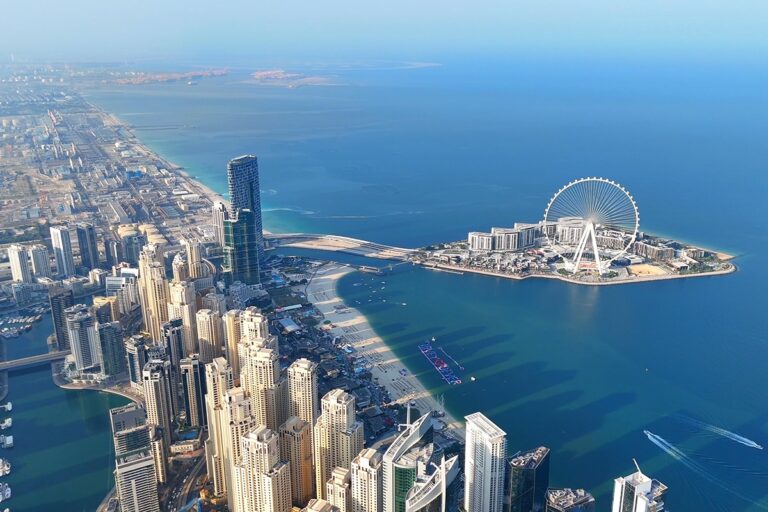
Technology is rapidly transforming the UAE’s real estate sector, changing not only how properties are bought and sold but also how investors manage their portfolios and residents experience their homes.
From blockchain-based property ownership to autonomous artificial intelligence systems, digital investment platforms and advanced air-quality monitoring, new technologies are becoming increasingly integrated into the country’s property market. Industry experts expect these developments to play a growing role in the next phase of UAE real estate growth.
The shift comes as Dubai’s residential property market recorded AED25.95 billion ($7.1 billion) in sales from 12,748 transactions in July 2026. Although activity has moderated compared with the exceptionally strong market of the previous year, off-plan properties continue to attract significant buyer interest.
One of the most notable developments is real estate tokenisation. Blockchain technology can allow high-value properties to be divided into digital units, giving investors the opportunity to gain fractional exposure to assets without purchasing an entire property. The approach could broaden access to luxury and large-scale real estate while potentially improving investment liquidity.
The Dubai Land Department has also been pursuing initiatives to digitise a portion of property transactions, with an ambition to cover up to 7 per cent of transactions, equivalent to around $16 billion, by 2033.
Artificial intelligence is another major force reshaping the sector. Instead of being limited to chatbots and basic customer-service tools, so-called agentic AI systems can perform tasks across leasing, property management, compliance and investment operations. AI could qualify prospective tenants, arrange viewings, manage follow-ups and generate contracts, while investors can use such systems to analyse rental yields, portfolio performance and pricing scenarios.
Digital investor dashboards are also gaining importance, particularly in the off-plan market. These platforms can give buyers a centralised view of payment schedules, escrow information, construction progress and ownership documents, improving transparency throughout the purchasing process.
Meanwhile, technology is increasingly being used to improve residential health and wellness. Advanced air-quality systems can monitor pollutants, humidity and ventilation in real time, while purification technologies target allergens, pathogens and volatile organic compounds.
As technology becomes more deeply embedded in UAE property, developers and investors are increasingly viewing digital innovation not simply as an added feature, but as an important part of the future real estate experience.





+ There are no comments
Add yours