







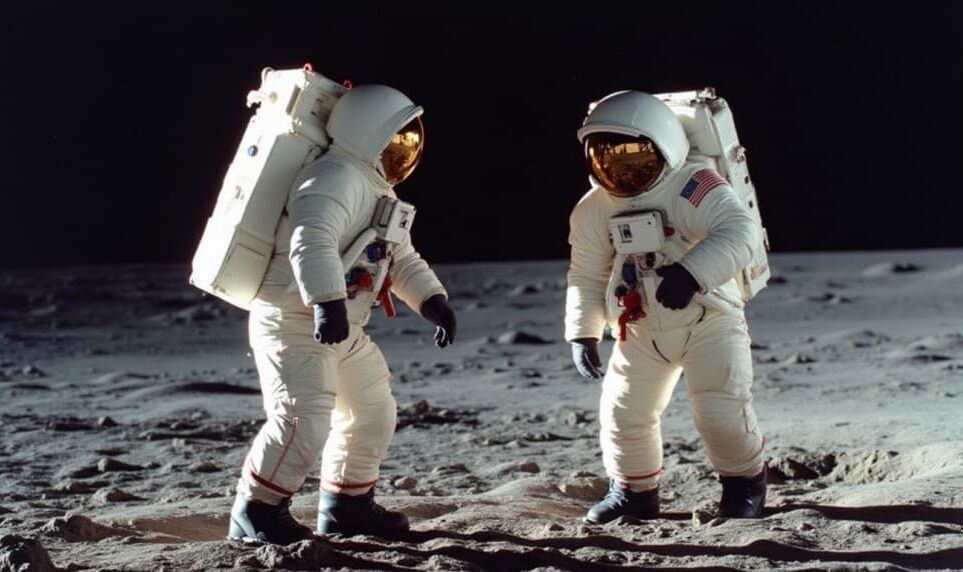
Exactly 57 years ago today, humanity achieved one of its greatest milestones when American astronauts Neil Armstrong and Buzz Aldrin became the first people to walk on the Moon, forever changing the course of space exploration and human history.
On July 20, 1969, NASA’s Apollo 11 mission successfully landed the lunar module Eagle on the Moon’s Sea of Tranquility after a four-day journey from Earth. Hours later, mission commander Neil Armstrong descended the ladder and became the first human to set foot on the lunar surface, delivering the now-famous words, “That’s one small step for man, one giant leap for mankind.” Shortly afterward, lunar module pilot Buzz Aldrin joined him, describing the Moon’s landscape as “magnificent desolation.”
The two astronauts spent about two and a half hours exploring the lunar surface, collecting 21.5 kilograms of Moon rocks and soil, conducting scientific experiments, and planting the United States flag. Meanwhile, command module pilot Michael Collins remained in lunar orbit, guiding the mission from above until his crewmates returned safely.
Apollo 11 fulfilled U.S. President John F. Kennedy’s ambitious goal of landing a man on the Moon before the end of the 1960s. The mission showcased remarkable advances in science, engineering, and international cooperation, inspiring generations to pursue careers in science and space exploration.
More than five decades later, the legacy of Apollo 11 continues to influence modern space missions. NASA’s Artemis program aims to return astronauts to the Moon and establish a long-term human presence, paving the way for future missions to Mars and beyond.
As the world marks the 57th anniversary of the historic Moon landing, Armstrong and Aldrin’s achievement remains a powerful symbol of human curiosity, courage, and determination. Their footsteps on the Moon continue to remind the world that seemingly impossible dreams can become reality through innovation, perseverance, and collaboration.









+ There are no comments
Add yours