







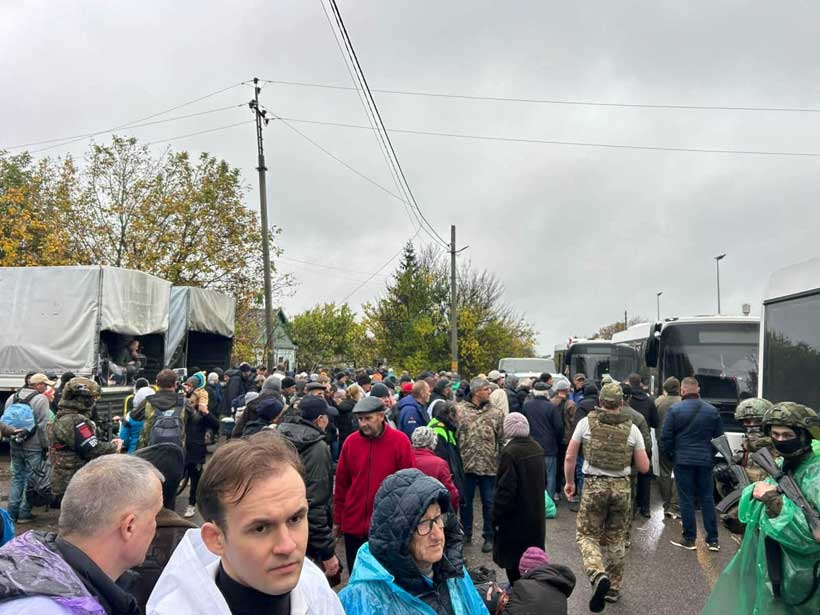
A fragile humanitarian pause in southern Ukraine has expired, raising fresh concerns for civilians trapped near the front lines as Ukrainian forces move hundreds of people away from threatened areas of the Kherson region.
A temporary ceasefire around the Russian-occupied town of Oleshky has expired, bringing uncertainty for residents who have been caught in the crossfire of Russia’s war against Ukraine. Ukrainian military authorities said they evacuated 167 people from threatened areas of the southern Kherson region on Sunday, as the six-day humanitarian truce came to an end.
The development follows a rare humanitarian operation that allowed residents to leave Oleshky, a town under Russian control, and return to Ukrainian-controlled territory. Buses transported civilians to safety on October 31, offering a brief moment of relief to families living under the threat of continuing military operations.
The temporary ceasefire, which covered Oleshky and surrounding areas, was reached following mediation efforts involving US First Lady Melania Trump and Pope Leo. The arrangement demonstrated an unusual diplomatic effort to create a humanitarian corridor despite the continuing confrontation between Moscow and Kyiv.
According to Ukrainian officials, both sides respected the temporary ceasefire agreement during its six-day duration. The truce expired at midnight Moscow time, equivalent to 2100 GMT on Sunday. However, there was no immediate indication of renewed hostilities following its expiration.
For civilians in the region, the end of the agreement has raised concerns about what happens next. Kherson remains one of the most dangerous areas of southern Ukraine, with communities facing repeated attacks, destruction of infrastructure and growing difficulties accessing essential services.
The evacuation operation highlights the enormous humanitarian consequences of the conflict, particularly for elderly residents, families with children and people unable to escape dangerous areas without assistance. Moving civilians away from threatened settlements remains a difficult task, requiring coordination, transportation and security arrangements between military and humanitarian authorities.
Ukraine’s human rights commissioner expressed hope that further humanitarian operations could take place, suggesting that the temporary arrangement might provide a foundation for additional civilian evacuations.
The latest developments also underline the importance of humanitarian diplomacy in a war that has repeatedly disrupted civilian life across Ukraine. Although the six-day agreement did not represent a broader breakthrough in negotiations between Russia and Ukraine, it created a limited opportunity to move people away from immediate danger.
With the ceasefire now expired, attention is turning towards the security situation around Oleshky and whether further evacuation arrangements can be negotiated.
For the residents who managed to escape, the operation represents a chance to reach safer territory. For those who remain behind, however, the end of the temporary truce brings renewed uncertainty as the wider war continues without a lasting peace agreement.








+ There are no comments
Add yours