






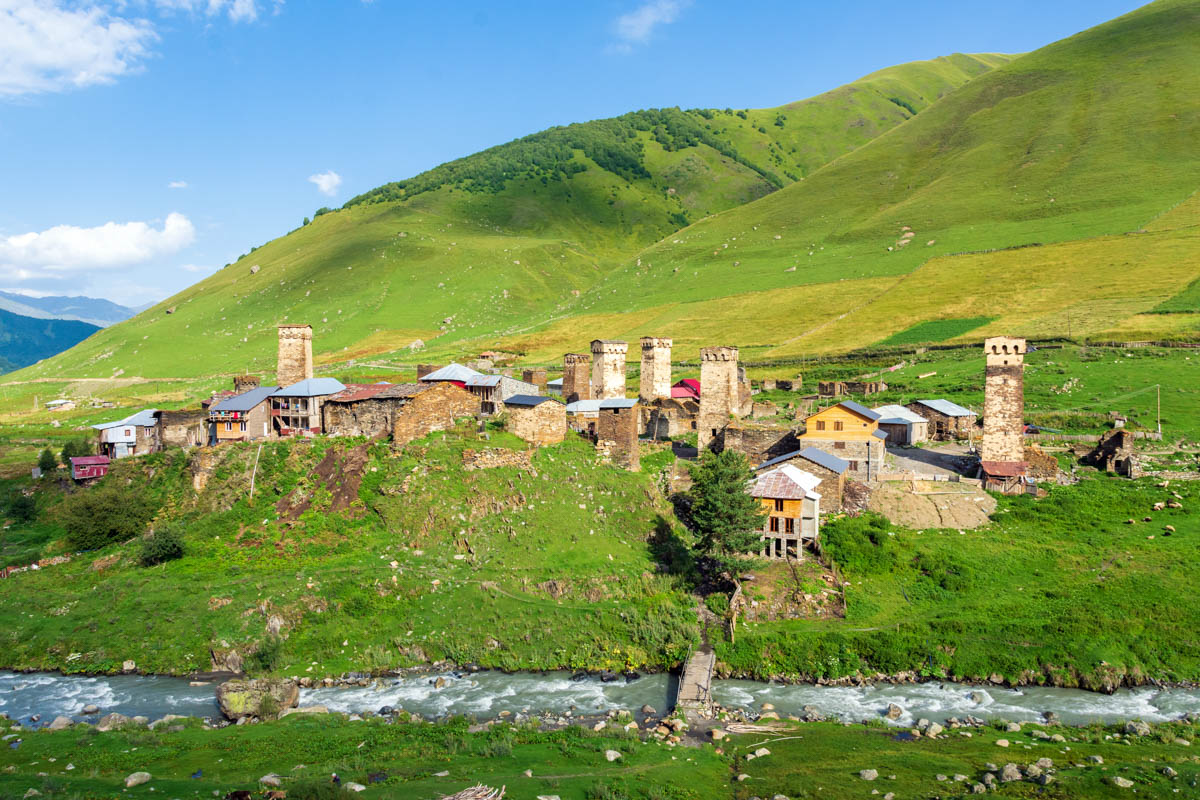
Hidden high in Georgia’s remote Caucasus Mountains, far from the noise of modern cities and the familiar routes of mass tourism, lies a remarkable mountain community where history is not confined to museums. In Ushguli, it rises above stone rooftops, stands along narrow village lanes and watches over everyday life from centuries-old defensive towers. Here, ancient architecture and living traditions exist side by side, creating a destination that feels almost untouched by time.
Situated in the Upper Svaneti region of northwestern Georgia, Ushguli is among Europe’s highest permanently inhabited settlements, lying at approximately 2,050 to 2,200 metres above sea level. Surrounded by dramatic mountain slopes, deep valleys and snow-covered peaks, the community offers a striking glimpse into a way of life shaped by isolation, harsh winters and the determination of generations who learned to survive in one of the Caucasus region’s most challenging environments.
Ushguli is not a single village but a community made up of four historic settlements: Chazhashi, Chvibiani, Zhibiani and Murkmeli. Together, they form an extraordinary cultural landscape in which traditional stone houses, medieval churches and distinctive defensive towers dominate the scenery. The village of Chazhashi is particularly important, preserving more than 200 medieval tower houses, churches and castles. This exceptional architectural heritage forms part of Upper Svaneti, which was recognised as a UNESCO World Heritage Site in 1996.
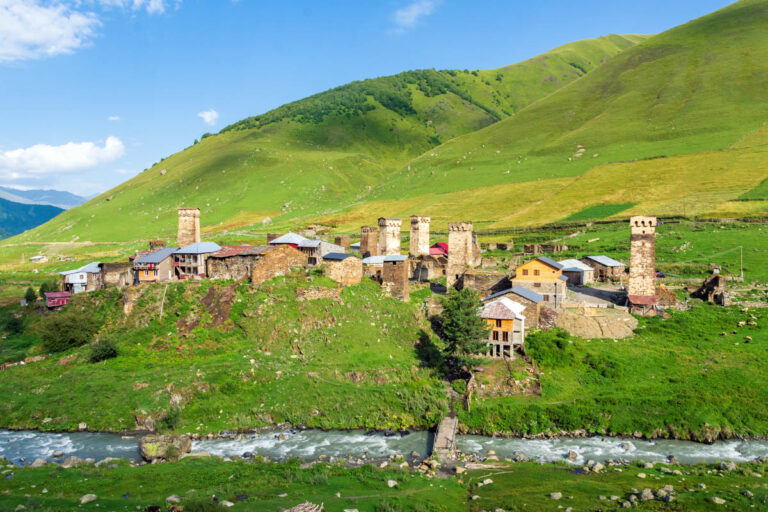
The most unforgettable feature of Ushguli is its famous Svan towers. Rising above the traditional stone houses, these narrow, imposing structures appear almost like guardians watching over the settlements. Built primarily between the medieval period and earlier centuries of local architectural development, the towers served practical purposes in communities where families often had to protect themselves from external threats and local conflicts. Their design reflects the difficult realities of mountain life, where geographical isolation offered protection but also demanded self-reliance.
Typically built with several floors and thick stone walls, the towers were designed to provide shelter, observation points and defensive positions. Their upper sections become narrower, giving them a distinctive silhouette against the mountain skyline. Some were connected to neighbouring residential buildings, allowing families to move between spaces while remaining protected. These structures were not simply symbols of power or wealth; they were part of the everyday security and social organisation of Svan communities.
The homes surrounding the towers reveal another fascinating aspect of traditional Svan architecture. Built largely from stone and adapted to the demanding mountain climate, many houses were designed to accommodate both people and livestock. The lower floors traditionally provided shelter for animals, while upper levels served as living spaces and storage areas. This practical arrangement helped families conserve warmth and make efficient use of limited resources during long, cold winters.
For the Svan people, who have inhabited this mountainous region for generations, architecture is closely connected to identity, family history and community traditions. Their distinctive language, folklore, music and customs have helped preserve a strong cultural identity. Geographic isolation played a significant role in maintaining these traditions, allowing local communities to retain practices that gradually disappeared or changed in more accessible parts of the world.
One of Ushguli’s most important cultural landmarks is the Lamaria Church, a historic religious site associated with the Virgin Mary. Standing amid the dramatic mountain landscape, the church reflects the deep influence of Christianity on Svan community life. Medieval churches across Upper Svaneti are also known for their religious artwork, including wall paintings and icons that represent important examples of Georgian artistic heritage. For local residents, these places are more than architectural attractions; they remain connected to faith, memory and community identity.
Ushguli is also associated with the legacy of Queen Tamar, one of Georgia’s most celebrated historical rulers, whose reign in the late twelfth and early thirteenth centuries is often remembered as a golden age in Georgian history. Local traditions connect certain historic towers and fortifications with her name. Although some of these associations belong to regional legend rather than firmly established historical fact, they demonstrate how closely the village’s identity is tied to Georgia’s national history and storytelling traditions.
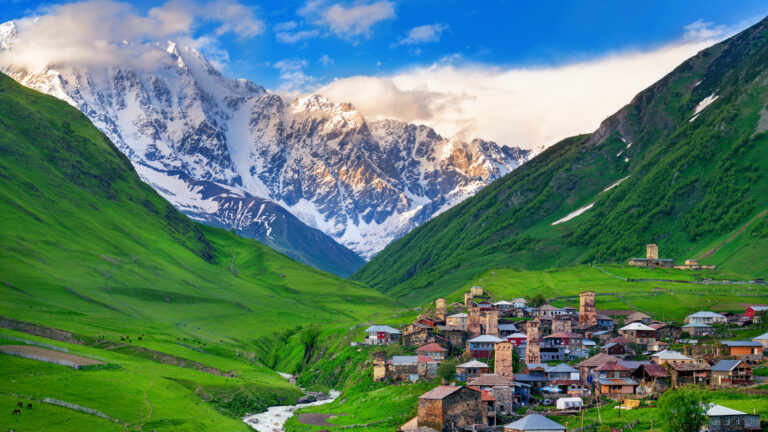
Beyond its architecture, the natural setting makes Ushguli extraordinary. The community lies beneath Mount Shkhara, Georgia’s highest mountain, which rises to approximately 5,203 metres. Its snow-covered summit dominates the horizon, creating a dramatic backdrop for the village’s ancient towers and stone buildings. The nearby Enguri River winds through the valley, while alpine meadows, glaciers and rugged mountain slopes transform the surrounding landscape with the changing seasons.
For travellers who enjoy walking and outdoor exploration, the region offers opportunities to experience the Caucasus at close range. One of the best-known routes leads from Ushguli towards the Shkhara Glacier, taking visitors through open meadows and along the Enguri River. The journey provides spectacular mountain views and a closer appreciation of the natural environment that has shaped life in this remote community. Conditions can change quickly at high altitude, however, and visitors should respect local advice and mountain safety guidance.
The seasons give Ushguli very different personalities. During summer, green fields, flowing rivers and relatively accessible mountain paths attract hikers and travellers. The villages appear especially striking beneath clear skies, with their stone towers standing against the enormous mountain backdrop. Autumn brings changing colours and a quieter atmosphere, while winter covers the settlements in snow and can make travel difficult. Heavy snowfall and challenging road conditions have historically contributed to the community’s isolation, reinforcing the importance of local knowledge and preparation.
Reaching Ushguli is part of the experience. Most visitors travel through Mestia, the main town of Upper Svaneti, before continuing along a mountain road towards the villages. The journey passes through spectacular valleys and remote settlements, offering glimpses of the region’s distinctive architecture and landscape. Road conditions can vary with weather and season, so travellers should check local transport information before setting out.
Despite its remote location, Ushguli is not frozen in the past. Families continue to live in the community, maintain homes, care for animals and welcome visitors. Small guesthouses and locally run accommodation have created opportunities for tourism, allowing travellers to experience traditional hospitality while supporting the local economy. Visitors may encounter regional dishes, homemade products and stories passed down through generations. The local way of life remains an essential part of the destination’s appeal.
However, increased tourism also brings challenges. Historic buildings require careful conservation, and the character of the villages depends on maintaining a balance between visitor demand and the needs of permanent residents. Traditional architecture can be damaged by inappropriate renovation, while greater commercial activity may gradually change the atmosphere that makes Ushguli distinctive. Protecting its heritage requires cooperation between local communities, conservation authorities and tourism businesses.
UNESCO recognition has helped bring international attention to Upper Svaneti, but it also underlines the responsibility to preserve the region’s fragile cultural landscape. The towers, churches, houses and surrounding environment form a connected heritage that cannot be understood by looking at individual monuments alone. Their real significance lies in the relationship between architecture, nature and the people who have maintained this mountain community over centuries.
In an age when many travel destinations are increasingly defined by luxury resorts, crowded attractions and carefully designed tourist experiences, Ushguli offers something different. Its appeal lies in its authenticity: stone walls weathered by time, narrow pathways between historic homes, distant church bells and ancient towers that remain part of the village skyline. It invites visitors to slow down, observe and understand a community whose history is still visible in its everyday surroundings.
Ushguli is more than a picturesque mountain destination in Georgia. It is a living reminder of how communities adapt to difficult environments, preserve their cultural identity and carry their history into the present. Beneath the towering peaks of the Caucasus, its medieval structures continue to stand as powerful symbols of resilience. Long after visitors leave, the image of those ancient towers rising above the quiet mountain villages remains unforgettable a rare place where the past has not disappeared, but continues to stand guard over everyday life.






+ There are no comments
Add yours