






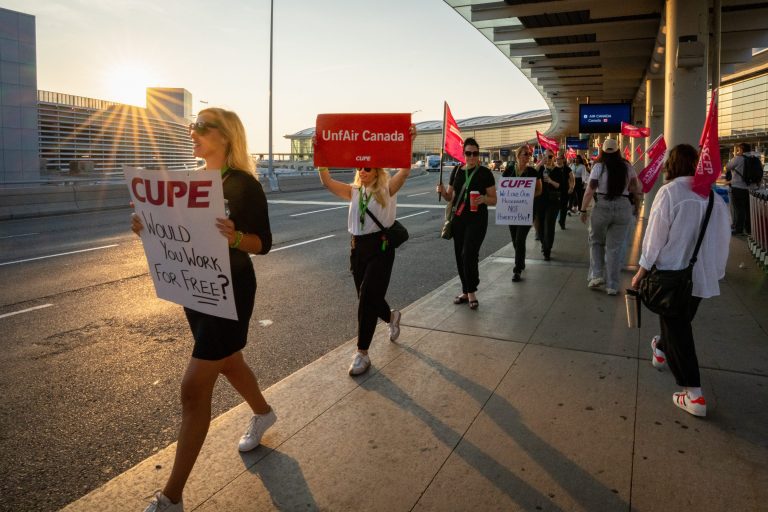
In a dramatic intervention that underscores the critical role of the aviation sector in Canada’s economy, the federal government has ordered Air Canada flight attendants back to work, mandating binding arbitration after a strike left more than 100,000 passengers stranded across the country and abroad.
The decision follows days of travel chaos, with canceled flights, overcrowded airports, and thousands of frustrated passengers grappling with disrupted travel plans.
The Strike That Halted Canada’s Largest Airline
The strike began when negotiations between Air Canada and the Canadian Union of Public Employees (CUPE), representing over 9,000 flight attendants, collapsed over issues such as:
Wages and cost of living: Flight attendants argued that pay increases were not keeping pace with inflation, leaving many struggling with rising housing and living costs.
Working conditions: Union leaders raised concerns about fatigue from long shifts, irregular schedules, and insufficient rest periods.
Job security and staffing levels: The union accused the airline of cost-cutting measures that stretched crews thin, impacting both employee well-being and passenger safety.
Within 24 hours of the strike, Air Canada was forced to ground dozens of flights, affecting hubs in Toronto, Montreal, Vancouver, and Ottawa. International flights were hit hardest, as staffing shortages rippled across the network.
Government Steps In
Faced with mounting public anger and the potential for broader economic disruption, the federal government invoked its authority to declare the strike a threat to the “national interest.” By doing so, it ordered an end to the work stoppage and required both sides to submit to binding arbitration, where a neutral third party will decide on the terms of a new contract.
Transport officials emphasized that while the right to strike is protected, essential services like national air travel cannot be allowed to collapse entirely. The government argued that keeping air transportation functioning was crucial not just for passengers but also for cargo, tourism, and Canada’s global reputation.
Reaction From Key Stakeholders
Flight Attendants and the Union
Union leaders expressed disappointment, accusing the government of undermining workers’ bargaining power. “This decision takes away our ability to use collective action to secure fair treatment,” one union spokesperson said. While acknowledging arbitration ensures movement toward resolution, many flight attendants felt their voices had been muted.
Air Canada Management
The airline welcomed the intervention, stressing that the strike had caused immense disruption. Executives argued they had already put “fair and reasonable” offers on the table and expressed hope that arbitration would restore stability for employees and travelers alike.
Passengers
For the more than 100,000 passengers stranded, reactions were mixed. Some welcomed the government’s decision, desperate to get home or resume business travel. Others sympathized with flight attendants, saying that poor working conditions ultimately affect the passenger experience as well.
The Human Impact
At Toronto Pearson International Airport, lines of frustrated passengers stretched across terminals, with travelers sleeping on the floor or scrambling to book alternative flights. Families missed vacations, students were delayed returning to universities, and businesses faced costly interruptions.
The chaos highlighted how reliant Canadians are on Air Canada, which operates the majority of domestic and international routes out of the country. Few alternative carriers had the capacity to absorb the sudden surge in demand.
What Happens Next?
The arbitration process will now determine the outcome of the labor dispute. A panel will review the union’s demands and Air Canada’s offers before issuing a binding decision. This could take weeks or even months, though flights are expected to resume immediately as workers return under government order.
Key questions include:
Will arbitration grant significant wage hikes, or will compromises prevail?
Will working condition reforms, like mandatory rest periods, be prioritized?
How will this set a precedent for future labor disputes in essential industries?
A Precedent for Labor Relations in Canada
The government’s decision has sparked debate. Critics argue it erodes the right to strike, setting a precedent that could embolden corporations in future negotiations. Supporters contend that in industries vital to national infrastructure, strikes must have limits to protect the public.
This moment may become a case study in balancing workers’ rights with public necessity—especially in aviation, where disruptions ripple quickly through the economy.
By forcing Air Canada flight attendants back to work and mandating arbitration, the Canadian government has ended one of the most disruptive labor disputes in recent aviation history. Over 100,000 stranded passengers will now be able to continue their journeys, but the underlying tension between worker rights and national interest remains unresolved.
As arbitration moves forward, both sides—and the traveling public—will watch closely. The final decision could reshape not only Air Canada’s workforce dynamics but also the broader approach to labor disputes in Canada’s essential industries.















+ There are no comments
Add yours