







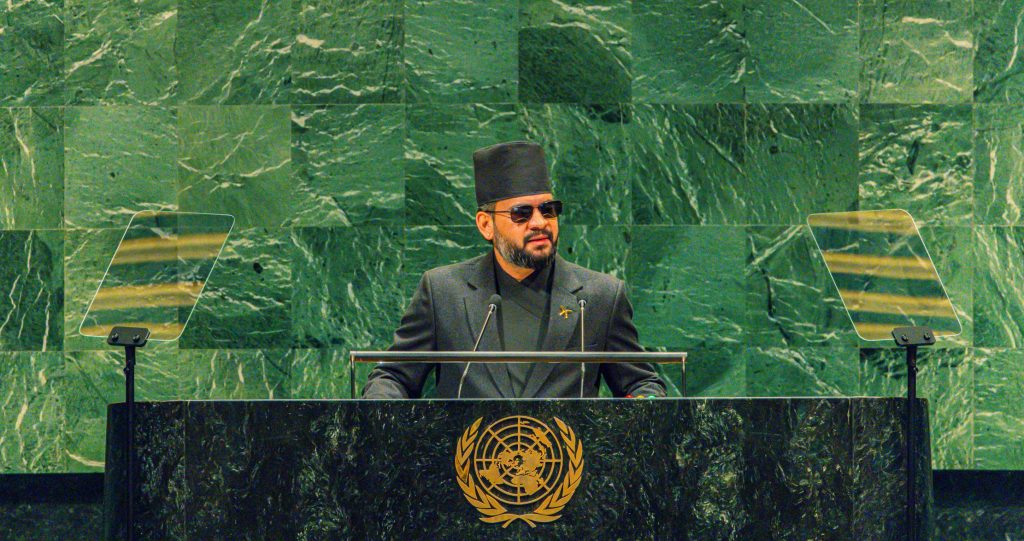
Nepal Prime Minister Balendra Shah used his first address to the United Nations General Assembly to bring the devastation caused by recent floods in the Himalayas to the centre of the global climate debate, warning that the disaster was not simply a national tragedy but a broader warning about the consequences of a changing climate.
Addressing the 81st session of the General Assembly on September 24, Shah described the destruction caused by the Bhotekoshi-Trishuli disaster, highlighting deaths, missing people and the loss of roads, bridges, schools, homes and livelihoods. He argued that for Nepal, climate-related disasters have become a development emergency because years of economic progress can be wiped out within hours.
Shah said Nepal contributes less than 0.1 percent of global greenhouse-gas emissions, yet the country is facing retreating glaciers, increasingly unstable mountain slopes and unpredictable rivers. He called for greater international responsibility toward countries that face severe climate consequences despite having contributed relatively little to global emissions.
One of the central proposals in his speech was the creation of a Himalayan Climate Resilience Mechanism, led by Nepal, India and China. Shah said the initiative could promote cooperation on satellite data, monitoring dangerous glacial lakes, early-warning systems and cross-border disaster response. The proposal reflects the transboundary nature of climate risks in the Himalayan region, where floods and other hazards can affect communities across national borders.
The Nepalese leader also called for stronger financial support for vulnerable countries. He argued that nations facing climate disasters should not be forced to accumulate additional debt simply to rebuild infrastructure destroyed by events linked to climate change. Shah urged greater access to grant-based climate finance and said existing international mechanisms need to become faster and easier to access.
His speech also widened beyond Nepal’s immediate disaster. Shah questioned global priorities, contrasting the speed at which military equipment moves across borders with the difficulties poorer countries can face obtaining essential goods such as fertilizer and fuel. He used the comparison to argue for a global system that places greater emphasis on human security, development and equitable access to resources.
Shah called for a shift from reacting to disasters after they occur toward preparing communities before the next crisis. He urged greater investment in resilient infrastructure, insurance, innovation and early-warning systems, while also calling for reduced dependence on fossil fuels.
The address came as Nepal sought to draw international attention to the vulnerability of the Hindu Kush Himalaya, a region that Shah said is home to nearly two billion people and provides water, ecosystems, agriculture and livelihoods far beyond Nepal’s borders. His message was that protecting the Himalayan environment is not solely a Nepalese concern but part of a wider international challenge.
Shah also connected climate action with the future of developing and vulnerable countries, calling for a stronger multilateral system in which smaller nations have a greater voice. His government, he said, is focused on building a state capable of delivering jobs, social protection and opportunities while strengthening the country’s ability to withstand future disasters.
The speech has since attracted international coverage, with reports focusing particularly on Shah’s warning that Nepal’s floods should be understood as a signal of growing climate risks and on his proposal for greater Himalayan cooperation.
For Nepal, Shah’s UN appearance placed the country’s recent disaster within a much larger international conversation about climate responsibility, resilience and development. His central message was that the warning coming from the Himalayas should not be treated as a distant regional problem, but as a signal of challenges that increasingly cross borders and affect the wider world.








+ There are no comments
Add yours