






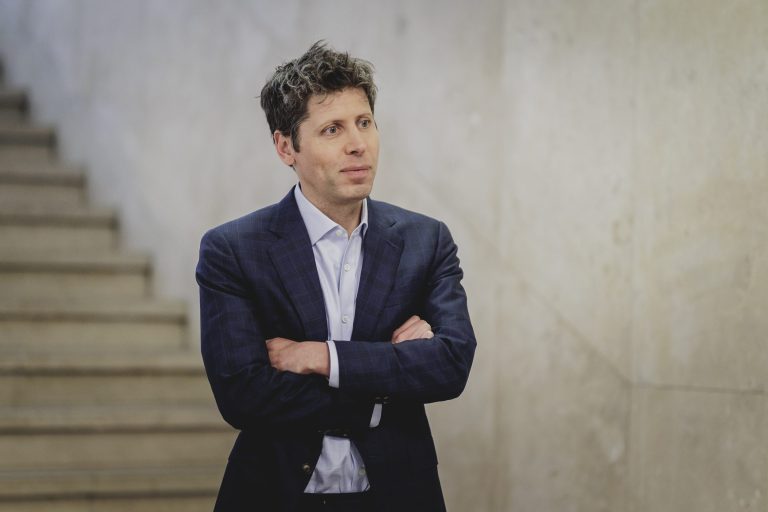
OpenAI CEO Sam Altman has once again set the tech and investment world buzzing. In a recent discussion, Altman revealed that the company’s annual revenue is “well more” than $13 billion, a figure that already surpasses most estimates circulating in the media. Even more striking was his long-term vision — he hinted that OpenAI could reach $100 billion in annual revenue by 2027, signaling one of the fastest growth trajectories ever for a tech company.
🚀 From Startup to Industry Powerhouse
Founded in 2015 as a research lab, OpenAI has transformed into a global AI juggernaut. With its flagship product ChatGPT, the company didn’t just build a viral app — it redefined how consumers, creators, and corporations interact with technology.
In just two years since ChatGPT’s public release, OpenAI has grown into the fastest-scaling software enterprise in history, outpacing the early growth rates of Google, Facebook, and even Apple’s App Store. Its revenue engine comes primarily from ChatGPT Plus subscriptions, API licensing, and enterprise partnerships with companies integrating OpenAI’s models into their operations.
Altman’s statement about revenues being “well above” $13 billion suggests that the company’s growth has far exceeded Wall Street expectations. Analysts previously believed OpenAI’s run rate hovered between $12–14 billion, but Altman’s remarks hint that the true figure may now be closer to $16–18 billion annually.
💼 What’s Driving This Growth?
ChatGPT Enterprise Expansion
OpenAI’s enterprise-focused product, launched in late 2023, is seeing widespread adoption among Fortune 500 companies. From banking to manufacturing, firms are using GPT models to automate workflows, generate reports, and assist customer service — cutting costs while improving productivity.
API Usage Explosion
Developers are embedding GPT models into apps, websites, and corporate systems at record levels. API revenue has surged as businesses seek AI capabilities without building their own large language models (LLMs).
Partnerships with Microsoft
The partnership with Microsoft remains a cornerstone of OpenAI’s ecosystem. Through Azure OpenAI Service, thousands of companies access ChatGPT and DALL·E capabilities directly through Microsoft’s cloud infrastructure — fueling a steady stream of revenue for both firms.
DALL·E and Sora Monetization
OpenAI’s creative tools, such as DALL·E 3 for image generation and the highly anticipated Sora video generator, are opening new monetization avenues. These products appeal not just to individuals but also to advertisers, media companies, and digital creators looking to automate visual content creation.
AI in the Workplace Revolution
The adoption of AI assistants for productivity — scheduling, research, data entry, and even marketing — is skyrocketing. Altman’s vision of “AI as a daily tool for every worker” is becoming reality, giving OpenAI massive recurring revenue potential.
💰 The $100 Billion Ambition
Altman’s mention of $100 billion in revenue by 2027 might sound bold, but not unrealistic considering current trends. If OpenAI maintains a compounded annual growth rate (CAGR) of 70–80%, it could easily reach that number within two years.
To put it in perspective:
Google took around 10 years to reach $50 billion in annual revenue.
Facebook (Meta) crossed that mark in roughly 9 years.
OpenAI could potentially double that in just five years from the launch of ChatGPT.
This would not only make OpenAI the fastest-growing company in history but also position it among the top 5 most valuable corporations globally, rivaling the likes of Apple, Microsoft, and Amazon.
🧠 Sam Altman’s Strategy: Scale and Integration
Altman’s leadership style blends ambitious scaling with deep integration. Unlike traditional tech CEOs who focus narrowly on product lines, Altman’s strategy involves embedding OpenAI’s technology across industries — from education and healthcare to entertainment and government services.
He frequently emphasizes that OpenAI’s success isn’t just about “building smarter models,” but about building platforms that integrate into human workflows. This approach ensures that the company doesn’t rely on a single product but on a growing AI ecosystem — a network effect that compounds its revenue potential.
⚙️ The Future of AI Economics
If OpenAI achieves $100 billion in revenue by 2027, it would redefine not only corporate growth benchmarks but also the economics of artificial intelligence.
Here’s what it could mean for the global market:
AI becomes a core business utility, like electricity or the internet.
Mass adoption in small businesses through affordable AI assistants.
Exponential rise in AI-driven employment — prompting the creation of millions of new roles in data, prompt engineering, digital design, and AI integration.
Regulatory transformation, as governments introduce frameworks to oversee AI’s economic and ethical impact.
🌐 OpenAI’s Wider Impact
Beyond profits, OpenAI’s rapid expansion is shaping how people live, learn, and work. ChatGPT has become an everyday tool for over 200 million active users, influencing education, corporate communication, and creative industries.
Altman’s goal of reaching $100 billion isn’t purely financial — it’s symbolic of a new era where AI powers global productivity. In many ways, OpenAI is positioning itself not just as a company, but as an AI infrastructure for the world.
🔮 What Lies Ahead
As OpenAI prepares for this next growth phase, several upcoming developments could further accelerate revenue:
ChatGPT 5 and multimodal AI, offering voice, vision, and reasoning capabilities.
Sora’s full rollout, bringing realistic AI-generated video to the mainstream.
Enterprise-level AI agents, capable of executing full business processes autonomously.
Global expansion, with localized AI products tailored to non-English-speaking markets.
📈 Bottom Line
Sam Altman’s claim that OpenAI’s revenue is “well more” than $13 billion — and his projection of $100 billion by 2027 — underscores the scale of the AI revolution already underway.
Whether it’s through enterprise solutions, creative AI, or global integration, OpenAI’s trajectory represents a historic transformation in how technology creates value.
If Altman’s projections hold true, by 2027 OpenAI won’t just be a company — it will be the defining economic force of the 21st century’s digital age.













+ There are no comments
Add yours