






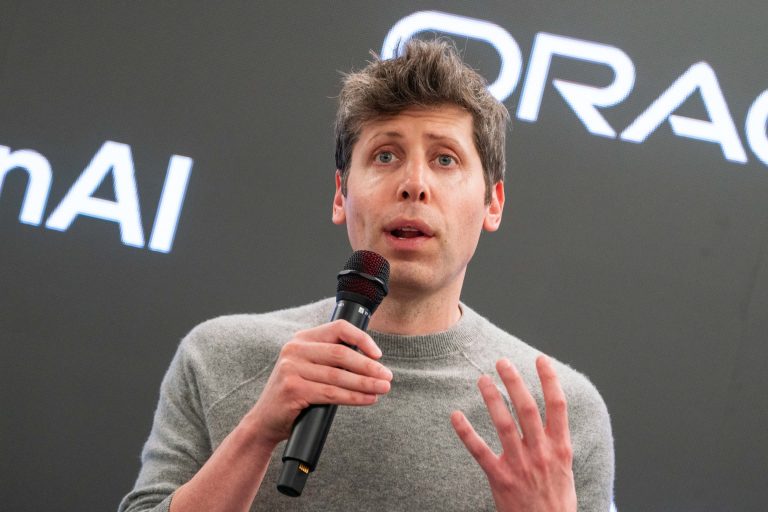
OpenAI CEO Sam Altman, one of Silicon Valley’s most influential tech leaders, recently revealed something unexpected: he’s envious of Gen Z college dropouts. While most CEOs might advise young people to finish school or pursue structured careers, Altman admires those who take the leap early — the ones who step away from formal education to chase new ideas, experiment freely, and create the next wave of innovation.
In a conversation about entrepreneurship and the future of technology, Altman said that young founders, especially Gen Z, have a distinct advantage: mental space. That’s something even top executives find hard to come by. And in the age of AI, he believes that mental space — time to think, tinker, and build — is the most valuable currency for innovation.
The Power of Mental Space in the Startup World
Altman’s comment isn’t just a compliment to a younger generation. It’s a reflection of how he sees creativity and innovation evolving. He argues that true breakthroughs rarely come from busy, over-scheduled professionals, but from individuals who can dedicate time and focus to exploring new frontiers — without fear or distraction.
“Having the mental space to think deeply and build things from scratch,” he said, “is one of the biggest advantages young entrepreneurs have today.”
For Altman, this “mental space” is the modern version of what 1990s garage startups once had — the freedom to fail fast, learn fast, and iterate without pressure. It’s something that’s increasingly rare in a hyperconnected world where attention is fragmented across constant notifications, deadlines, and information overload.
Why Gen Z Has a Unique Advantage
Gen Z, in Altman’s eyes, is uniquely positioned to lead the next big wave of innovation. Unlike previous generations that followed more conventional career paths, many members of Gen Z are already building apps, running online businesses, or creating content before they graduate high school.
They’re digital natives — comfortable with technology, adaptable to change, and unafraid of experimenting with new tools like artificial intelligence. In fact, some of today’s most promising startup founders are in their late teens or early 20s, using AI platforms like OpenAI’s ChatGPT and GPT models to create new products at lightning speed.
Altman notes that this generation’s fearlessness, paired with their deep familiarity with emerging technologies, gives them a creative edge that older, more risk-averse professionals often lack.
Dropping Out Isn’t About Rebellion—It’s About Focus
Sam Altman himself dropped out of Stanford University after just one year — a decision that shaped his own entrepreneurial journey. He understands firsthand that dropping out isn’t necessarily about rejecting education, but about recognizing where one’s time is best spent.
He has often said that the most successful founders are those who are obsessed with an idea and willing to give up everything to pursue it. For many Gen Z creators, college simply doesn’t provide the right environment for that level of focus.
By leaving school, some find the mental space to work on projects full time, test ideas quickly, and immerse themselves in real-world problem-solving — an experience that traditional classrooms can rarely replicate.
Still, Altman’s admiration for college dropouts isn’t an endorsement for everyone to leave school. Rather, it’s an acknowledgment that structured education isn’t the only path to innovation. The key, he says, is whether you can create the conditions — mentally and emotionally — to build something truly original.
The AI Era and the New Entrepreneurial Frontier
Altman’s comments come at a pivotal time for technology and business. With AI tools like ChatGPT, DALL·E, and Codex transforming industries, barriers to starting a company have never been lower. A single motivated young founder can now do what once required a full engineering team.
That shift is democratizing entrepreneurship. Gen Z founders are using AI to automate workflows, generate code, design marketing campaigns, and even create entire business models within weeks. In Altman’s view, this democratization makes the idea of “mental space” even more critical — because anyone with vision and focus can now build something world-changing.
The future of startups, he suggests, will belong to those who use AI not just as a tool, but as a creative partner — turning ideas into prototypes faster than ever before.
A CEO’s Envy of the Unburdened Mind
When Altman says he’s envious, it’s not about age — it’s about freedom. As a CEO running one of the world’s most watched AI companies, his time is consumed by meetings, investor expectations, and global scrutiny. The simplicity of being a young entrepreneur — free to think deeply and build passionately — is something he misses.
He describes it as the period when “you can just wake up and write code all day, or think about one idea for a week straight.” That, he believes, is when some of the most transformative ideas are born.
Altman’s sentiment highlights a growing theme in Silicon Valley: the belief that structure, bureaucracy, and scale often stifle creativity. For Gen Z founders just starting out, that absence of structure is an asset — one that established executives can only look at with admiration.
What the Next Generation Can Learn
While not every college dropout will become the next tech visionary, Altman’s message is ultimately about mindset. It’s a call for young people to value curiosity, experimentation, and long-term thinking over credentials or conventional success markers.
He often advises aspiring founders to focus less on chasing investors or trends and more on solving real problems — ones they care about deeply. “If you work on something you truly love,” he once said, “you’ll put in the time and energy to make it great.”
That philosophy resonates with Gen Z, a generation known for prioritizing purpose over prestige and meaning over money.
The Future Is Being Built by Those Who Think Differently
Altman’s admiration for young founders isn’t nostalgia; it’s recognition. He knows the next OpenAI, the next Stripe, or the next Reddit might already be forming in a dorm room—or in the mind of someone who decided to leave college altogether.
In an era where AI is rewriting what’s possible, innovation belongs to those who think boldly, move fast, and embrace experimentation. And as Sam Altman sees it, Gen Z has exactly what the world of technology needs most: unfiltered creativity, limitless energy, and the mental space to imagine what’s next.













+ There are no comments
Add yours