






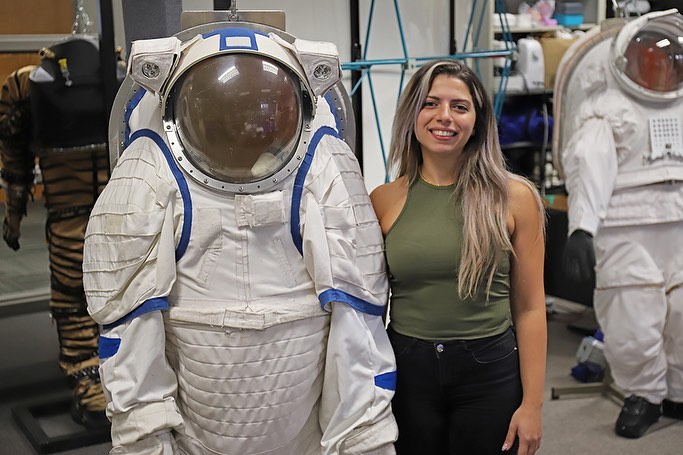
When Norah Al Matrooshi made history as the first African and Arab woman to go to space, the world saw the success. What few people saw was the punishing grind it took to get there—years of 4:30 a.m. wake-ups, intense astronaut training, and full-time work in the male-dominated tech industry.
Her journey is not only a monumental leap for representation in space exploration, but also a stunning testament to discipline, resilience, and ambition. In a world where balancing work and life is already tough, Norah was balancing orbit-class dreams with the reality of working 9 to 5 in a high-pressure engineering job.
This is the inside story of how she did it, and what her daily routine reveals about what it really takes to become an astronaut—especially when you’re breaking boundaries on multiple fronts.
Meet Norah Al Matrooshi: A Space Pioneer
Born in the United Arab Emirates, Norah Al Matrooshi grew up watching space documentaries and reading about astronauts like Valentina Tereshkova and Neil Armstrong. But for most of her childhood, there were no Arab women to look up to in space science.
That changed in 2021, when she was selected by the Mohammed Bin Rashid Space Centre (MBRSC) as part of the UAE Astronaut Program, in collaboration with NASA’s Johnson Space Center in Houston. She beat out thousands of applicants for the highly selective role.
In 2024, she officially began astronaut training with NASA as part of the Artemis Generation, setting the stage for potential missions to the International Space Station and eventually the Moon.
The Brutal Routine Behind the Breakthrough
Norah’s path was not paved in gold. While preparing for her astronaut candidacy, she was also working full-time as a mechanical engineer in the UAE’s energy sector—a demanding job in itself.
Here’s what her daily life looked like for nearly two years before she made it to NASA:
🔹 4:30 a.m. – Wake-Up & Physical Training
Before the sun rose, Norah was already in motion. She began her day with cardio and strength training, preparing her body for the extreme physical demands of astronaut life. This included:
High-intensity interval training (HIIT)
Swimming laps to simulate zero-gravity resistance
Strength conditioning and endurance
Physical fitness isn’t just about looking good—it’s mandatory for astronauts, who must operate in zero-gravity and endure massive G-forces during launch and re-entry.
🔹 6:30 a.m. – Study & Simulation Practice
After her workout, Norah dedicated time to studying spacecraft systems, orbital mechanics, and space medicine. She also worked on simulator programs for docking, re-entry, and emergency scenarios. She was often teaching herself subjects that would intimidate even advanced engineers.
🔹 8:00 a.m. – Start of Tech Job
She clocked in for her full-time job as a mechanical engineer by 8 a.m., working on oil and gas infrastructure, systems optimization, and project development. Her job required precision, long hours, and constant innovation—skills that would prove invaluable in astronaut training.
🔹 6:00 p.m. – Language and Flight Training
In the evenings, Norah took Russian language lessons—a must for any astronaut training with NASA or Roscosmos, the Russian space agency. She also began pilot lessons to understand cockpit protocols and in-flight safety measures.
🔹 9:00 p.m. – Lights Out
With barely any time for a social life, Norah made sleep a priority. Recovery was essential to maintain her strict routine and prevent burnout.
The Psychological Challenge: More Than Just Physical Grit
Being an astronaut candidate isn’t just about how well you lift weights or solve equations—it’s about mental toughness. Norah’s days were packed with mental simulations, team dynamics training, and psychological evaluation.
She was often the only woman—and the only Arab—in many rooms. That meant more scrutiny, higher expectations, and added pressure to perform. Instead of seeing this as a disadvantage, she used it as fuel.
“Every time I felt exhausted, I reminded myself that I’m not just doing this for me. I’m doing this for every young Arab girl who dreams of the stars,” Norah said in a NASA interview.
Training at NASA: A New Level of Intensity
Once accepted into NASA’s astronaut candidate program, the grind didn’t stop. It escalated.
Spacewalk training in the Neutral Buoyancy Lab, a massive swimming pool simulating space.
Survival training in deserts, oceans, and forests to prepare for off-course landings.
Advanced robotics, flight engineering, and ISS systems operations.
She trained alongside U.S. Air Force pilots, aerospace PhDs, and other top-tier professionals—each with unique strengths and pressure to match.
Why Norah’s Journey Matters
Norah Al Matrooshi’s ascent is more than a personal triumph—it’s a cultural revolution. She is:
The first Arab woman in NASA’s astronaut corps
A role model for millions of women across Africa and the Middle East
Proof that representation in space exploration is shifting
Her story resonates at a time when the global space sector is being pushed toward diversity, inclusion, and innovation.
The Takeaway: Dreaming Big Isn’t Enough—You Have to Outwork the Dream
What sets Norah apart isn’t just talent. It’s her relentless commitment to the process. Every 4:30 a.m. workout, every late-night study session, every sacrifice—it all added up to a history-making mission.
Her story is a message to anyone who dares to dream big: discipline beats doubt.
Final Words
As Norah gears up for her first official space mission, her story is already orbiting hearts and headlines across the globe. She’s not just reaching for the stars—she’s pulling the rest of us up with her.














+ There are no comments
Add yours