







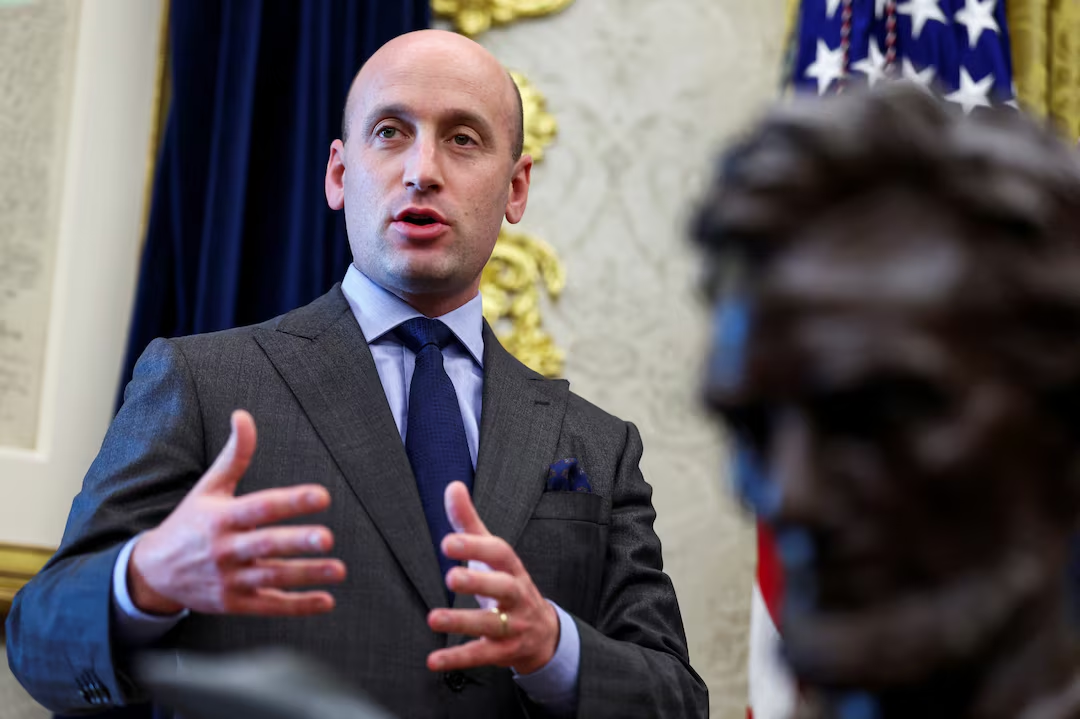
US President Donald Trump has appointed Stephen Miller, one of his closest advisers and the architect of his hard-line immigration policies, as the new White House chief of staff. The appointment comes days after Republicans suffered major losses in the midterm elections, raising questions about the administration’s future political direction.
Trump announced the decision on Friday, saying Miller would replace Susie Wiles and take up the position on Monday, 9 November.
Miller, who has served as deputy chief of staff since Trump’s return to the White House in January 2025, has played a central role in shaping the president’s domestic agenda, particularly immigration enforcement and restrictions on federal government programmes.
The appointment represents a significant change in the White House leadership at a politically challenging moment for the president.
A Key Figure Behind Trump’s Immigration Agenda
At 41, Miller has become one of the most influential figures in Trump’s political circle.
He has long advocated stricter immigration controls and played a major role in developing the administration’s deportation programme. His proposals have included expanding immigration arrests and increasing enforcement operations across the country.
Under the administration’s latest immigration campaign, officials have pursued a target of 3,000 arrests per day, a policy that has attracted criticism from civil rights groups and Democratic lawmakers.
Miller has also been involved in broader domestic policy initiatives, including changes to the federal workforce and the administration’s disputes with universities and diversity programmes.
Leadership Change After Republican Election Losses
The appointment follows a major political setback for Trump and the Republican Party in the midterm elections, with Democrats securing control of both chambers of Congress, according to election results reported this week.
The change in leadership could influence how the White House approaches its remaining political agenda.
With Democrats preparing to take control of Congress, the administration is expected to face increased scrutiny, particularly over immigration policies, government spending and executive authority.
Miller’s promotion may indicate that Trump intends to maintain his existing policy direction rather than pursue a major political shift.
Susie Wiles Moves Out of the White House Role
Miller will replace Susie Wiles, who became the first woman to serve as White House chief of staff when Trump returned to office in January 2025.
Wiles played a central role in managing Trump’s successful 2024 presidential campaign and subsequently oversaw the daily operations of his administration.
Trump praised her service and announced that she would move to the president’s political operation.
Wiles also confirmed her departure in a social media statement, describing her time in the White House as an honour and expressing continued support for the president.
What Miller’s Appointment Means for Washington
The White House chief of staff is one of the most powerful positions in the US administration. The role involves managing presidential schedules, coordinating senior advisers, overseeing internal operations and maintaining communication with government departments and lawmakers.
Miller’s appointment could have important implications for relations between the White House and the newly empowered Democratic leadership in Congress.
His influence over immigration and domestic policy is also likely to attract renewed attention as lawmakers prepare to examine the administration’s decisions.
For Trump, the leadership change marks a new phase of his presidency following an electoral setback. Whether Miller’s appointment helps the administration advance its agenda or deepens political divisions in Washington remains to be seen.








+ There are no comments
Add yours