





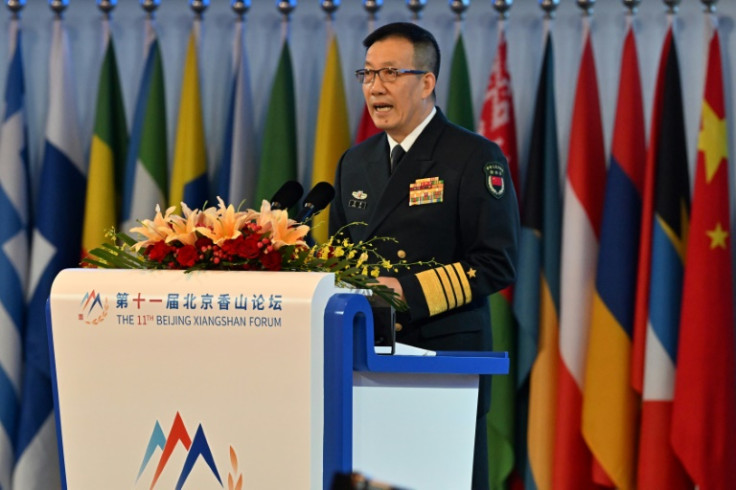
Chinese Defence Minister Dong Jun has called on countries to avoid provocative actions and work together to prevent a resurgence of what he described as regressive historical trends, delivering a message of restraint at a major international security forum in Beijing on Wednesday, September 16.
Speaking at the Beijing Xiangshan Forum, Dong emphasized the need for greater cooperation in global security governance and warned against militarism, hegemony and historical revisionism. His remarks came as tensions remain elevated across the Asia-Pacific, particularly around Taiwan, the South China Sea and China’s increasingly strained relationship with Japan.
Although Dong did not directly name Japan, the timing and wording of his comments were widely seen in international reporting as an indirect reference to recent tensions between Beijing and Tokyo. Relations between China and Japan have faced renewed pressure following Japanese remarks concerning how Tokyo could respond to a possible Chinese attack on Taiwan.
Dong said countries should avoid actions that could intensify confrontation and instead strengthen cooperation to address common security challenges. He argued that international security should be managed through greater equality and coordination rather than through coercion or unilateral approaches.
The defence minister’s comments also reflected China’s broader effort to promote its view of a more multipolar international security system. The Xiangshan Forum, one of China’s major platforms for defence diplomacy, brings together military officials, diplomats, academics and security experts from numerous countries.
This year’s forum is being held from September 15 to 17 under the theme of building consensus on stability and advancing security governance together. The event has provided Beijing with an opportunity to present its positions on international security while engaging with foreign defence officials and military representatives.
Regional security issues are particularly sensitive at a time when questions surrounding Taiwan continue to influence relations between China, Japan and the United States. The South China Sea is another major source of strategic competition, with several countries maintaining competing territorial claims and the United States continuing its security engagement in the wider Indo-Pacific.
Dong’s speech did not directly attack Washington or identify the United States and its allies by name. Instead, his comments focused on broader principles, including opposition to coercion, militarism and what Beijing considers attempts to revive outdated geopolitical approaches. Reuters reported that the language could be interpreted as indirect criticism of the United States and its partners without explicitly naming them.
The Chinese defence chief also highlighted emerging security challenges beyond traditional military competition. Other reporting from the forum said Dong called for international cooperation on areas including artificial intelligence and outer space, reflecting growing concern over how new technologies are changing the global security environment.
Artificial intelligence has increasingly become part of defence planning as governments examine its potential role in military decision-making, surveillance, cyber operations and autonomous systems. Competition over advanced technologies has also become an important part of the broader strategic relationship between China and the United States.
The Xiangshan Forum comes shortly before an expected meeting between Chinese President Xi Jinping and U.S. President Donald Trump, adding wider diplomatic significance to the security discussions taking place in Beijing. The two countries continue to manage disagreements involving trade, technology, security and regional influence.
For China, the forum also serves as an important venue for military diplomacy. The gathering allows Chinese officials to engage with foreign defence representatives at a time when Beijing is seeking greater influence in discussions about international security and the future of the global order.
Dong’s appeal for restraint comes as governments across the Indo-Pacific attempt to balance national security concerns with the need to avoid escalation. While countries continue to strengthen their military capabilities and partnerships, Chinese officials have repeatedly promoted dialogue and cooperation as alternatives to confrontation.
The message delivered by Dong therefore combines two themes: China’s call for greater international cooperation in managing security challenges and its warnings against what Beijing views as destabilizing military and historical trends.
The response to those arguments will depend heavily on developments across the region. Taiwan remains one of the most sensitive issues in China-U.S. relations, while disputes in the South China Sea and China’s relationship with Japan continue to shape the strategic environment in East Asia.
With defence officials and diplomats from around the world gathered in Beijing, Dong’s speech places China’s security vision at the center of an ongoing international debate over how countries should manage growing military competition, technological change and regional tensions.







+ There are no comments
Add yours