






Tanzania’s legendary Serengeti National Park has once again strengthened its position as one of the world’s most extraordinary wildlife destinations after being named Africa’s Leading Big 5 National Park 2026 at the World Travel Awards.
The prestigious recognition was announced during the World Travel Awards Africa Gala Ceremony held at Diamonds Bijoux Zanzibar on August 28. Serengeti also received the title of Africa’s Leading National Park, underlining its global reputation as one of the finest places on Earth to experience wildlife in its natural environment.
For generations, the Serengeti has represented the ultimate African safari. Its seemingly endless plains, dramatic wildlife encounters and spectacular annual migration have made it one of the continent’s most recognisable natural landscapes.
Spreading across approximately 1.5 million hectares of savannah and grassland, the Serengeti offers visitors a wilderness experience on a remarkable scale. Golden plains stretch towards distant horizons, interrupted by rocky kopjes, winding rivers, acacia trees and pockets of woodland.
The park is famous for the Big Five lion, leopard, elephant, buffalo and rhinoceros although every safari brings its own unpredictable encounters.
Lions can often be seen resting beneath trees or watching over the grasslands, while elusive leopards remain among the most exciting animals to spot. Elephants move through woodland and open plains in family groups, buffalo gather in large herds, and the endangered black rhinoceros remains one of the park’s most precious wildlife sightings.
But the Serengeti’s appeal extends far beyond the Big Five.
Cheetahs race across the open grasslands, giraffes move gracefully among acacia trees, hyenas patrol the plains and hippos gather in rivers and pools. Ostriches, antelope and hundreds of other species add to the extraordinary diversity of the ecosystem.
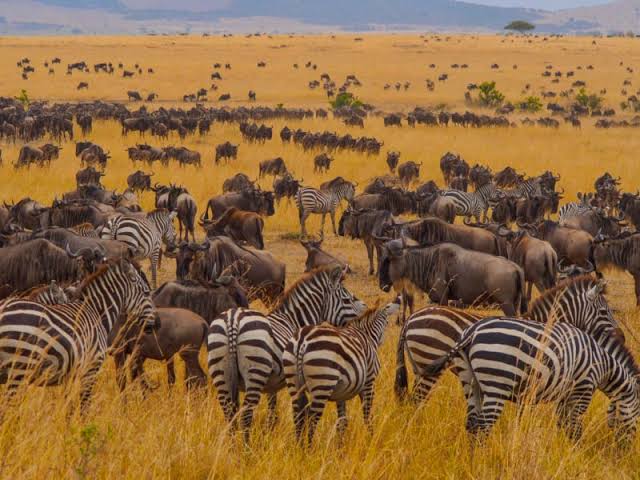
The Serengeti is also home to one of the greatest natural spectacles on the planet the annual migration of vast herds of wildebeest and zebra across the East African plains. The movement of millions of animals in search of fresh grazing creates an ever-changing wildlife drama involving predators, river crossings and some of nature’s most powerful survival stories.
UNESCO has recognised the Serengeti ecosystem for its exceptional biodiversity and extraordinary concentration of grazing animals and predators. The park is also home to more than 500 species of birds, making it a destination of exceptional importance for nature and wildlife tourism.
The latest World Travel Awards recognition is another major achievement for Tanzania’s tourism industry and highlights the continuing international appeal of its protected natural landscapes.
For visitors, however, the Serengeti is more than an award-winning destination.
It is the sight of a lion lifting its head from the grass. The distant movement of a giraffe beneath an endless sky. The sound of hooves crossing the plains and the sudden appearance of an elephant from the woodland.
In the Serengeti, wilderness is not simply something visitors observe.
It is something they experience vast, unpredictable and magnificently alive.








+ There are no comments
Add yours