







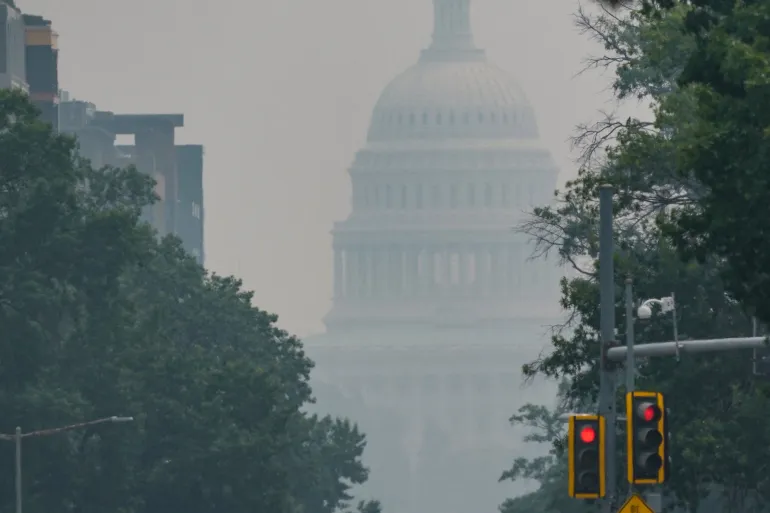
U.S. President Donald Trump has threatened to impose new tariffs on Canada after dense smoke from hundreds of uncontrolled wildfires spread across the border, blanketing large parts of the northern United States and reducing air quality in several major cities. The latest dispute has added fresh tension to U.S.-Canada relations, with Trump accusing Canada of failing to properly manage its forests and prevent the devastating fires.
In a post on his Truth Social platform, Trump claimed that the United States was being “unnecessarily invaded by filthy, polluted, and unhealthy air” and blamed what he described as Canada’s “willful negligence” in maintaining its forests and brush. He also announced plans to contact Canadian Prime Minister Mark Carney to demand an explanation, while warning that additional tariffs could be introduced in response to the cross-border smoke.
The comments come as Canada continues to battle one of its most severe wildfire seasons. According to the Canadian Wildland Fire Information System, approximately 888 wildfires were actively burning across the country as of Friday, with the majority remaining out of control. Ontario alone has reported more than 190 active fires, many of which continue to spread despite ongoing firefighting efforts.
The smoke has drifted southward, creating hazardous air quality conditions across several U.S. states and casting an orange haze over cities including New York. Health officials have urged residents, particularly children, older adults, and those with respiratory conditions, to limit outdoor activities as smoke levels remain elevated.
Ontario Premier Doug Ford responded by urging the United States to provide additional firefighting assistance rather than criticize Canada. He emphasized that the scale of the wildfires requires international cooperation and resources to protect communities and contain the blazes.
Prime Minister Mark Carney also stressed that climate change is contributing to increasingly intense wildfire seasons and said both Canada and the United States share a responsibility to address the growing environmental challenge. Despite the political exchange, Canadian officials maintain that firefighting crews continue to work around the clock under extremely difficult conditions.
The controversy has also reignited political debate among some Republican lawmakers, with several once again promoting Trump’s long-standing suggestion that Canada should become the 51st U.S. state. The renewed rhetoric has drawn criticism in Canada and further strained public sentiment between the two neighboring countries, even as both continue to face the shared consequences of one of North America’s most destructive wildfire seasons.









+ There are no comments
Add yours