







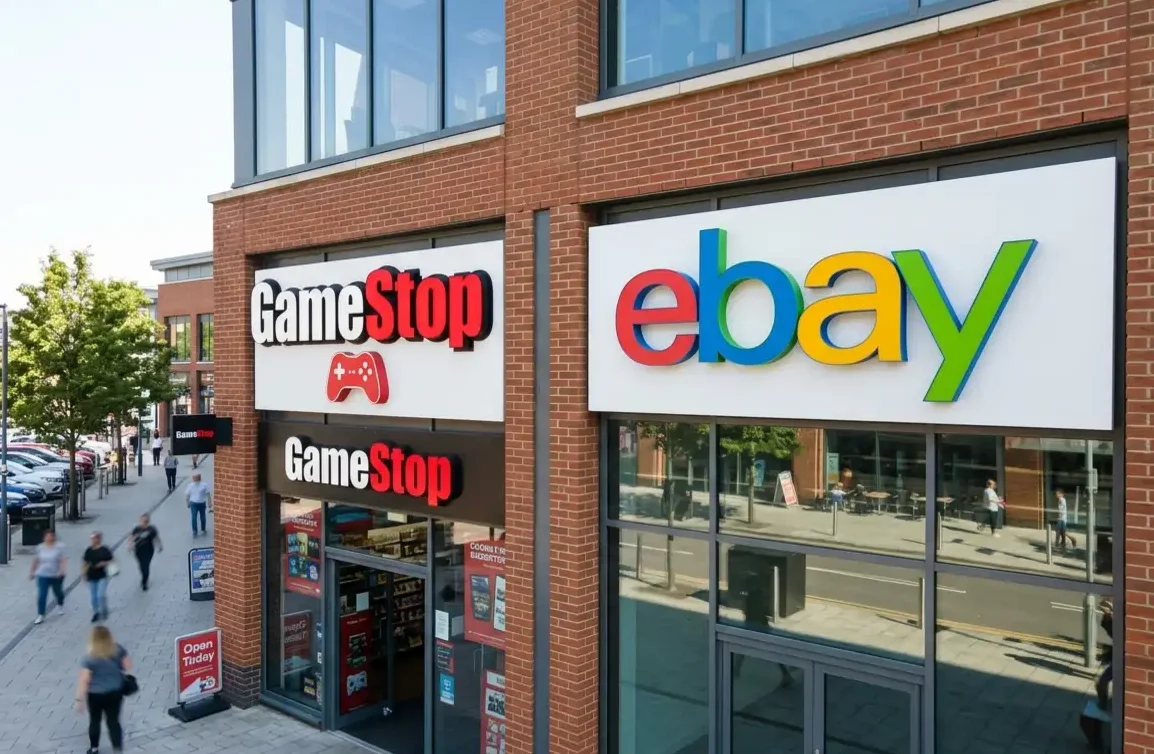
In a move that has immediately shaken investor sentiment and sparked intense debate across the financial sector, GameStop has unveiled a $56 billion cash-and-stock offer to acquire eBay Inc., marking one of the most ambitious takeover attempts in recent memory and signaling a dramatic escalation in its corporate strategy.
The proposal, announced on Sunday, represents a bold attempt by GameStop to reposition itself far beyond its traditional retail gaming identity. Under the leadership of CEO Ryan Cohen, the company is increasingly pursuing a vision centered on digital commerce, platform expansion, and long-term transformation into a broader e-commerce player. The proposed acquisition of eBay sits at the center of that strategy, aiming to merge GameStop’s evolving retail infrastructure with one of the world’s most established online marketplaces.
According to details shared by the company, the bid would be structured as a combination of cash and stock. While exact financing mechanisms remain unclear, the scale of the offer places it among the most significant technology-sector acquisition attempts in recent years. Market analysts have noted that the size alone is enough to force serious consideration, even if execution risks remain high.
What has drawn particular attention, however, is GameStop’s willingness to escalate the situation into hostile territory. The company has indicated that if eBay’s board declines to engage in discussions, it is prepared to take the offer directly to shareholders. Such a move would bypass traditional negotiation channels and place pressure on eBay investors to weigh the financial premium against strategic independence.
The reaction from markets was swift. GameStop shares experienced heightened volatility following the announcement, reflecting both excitement and uncertainty over the feasibility of such a large-scale acquisition. eBay’s stock also saw increased trading activity as investors attempted to assess whether the proposal might lead to negotiations, revisions, or outright rejection.
For eBay Inc., the bid arrives at a pivotal moment. The company has been working to streamline its operations, strengthen its core marketplace business, and compete in an increasingly crowded global e-commerce environment. While a takeover offer of this magnitude is likely to attract attention from shareholders, analysts caution that concerns over integration complexity, cultural alignment, and regulatory approval could weigh heavily on any decision-making process.
Industry observers remain divided on the seriousness and viability of the move. Some view it as a transformative attempt by GameStop to reinvent itself on a global scale, leveraging eBay’s infrastructure to accelerate its shift into digital marketplaces. Others see significant obstacles, pointing to the operational gap between the two companies and the immense challenge of integrating large-scale international platforms.
Still, the involvement of Ryan Cohen adds further intrigue, given his reputation for aggressive strategic positioning and willingness to challenge conventional corporate boundaries. Whether this bid ultimately develops into formal negotiations or becomes another example of high-profile market signaling, it has already succeeded in reshaping attention toward both companies.
As discussions and speculation continue, regulators, investors, and competitors are expected to closely monitor developments. The outcome could have wide-ranging implications not only for GameStop and eBay, but for the broader direction of consolidation within the global e-commerce sector.









+ There are no comments
Add yours