







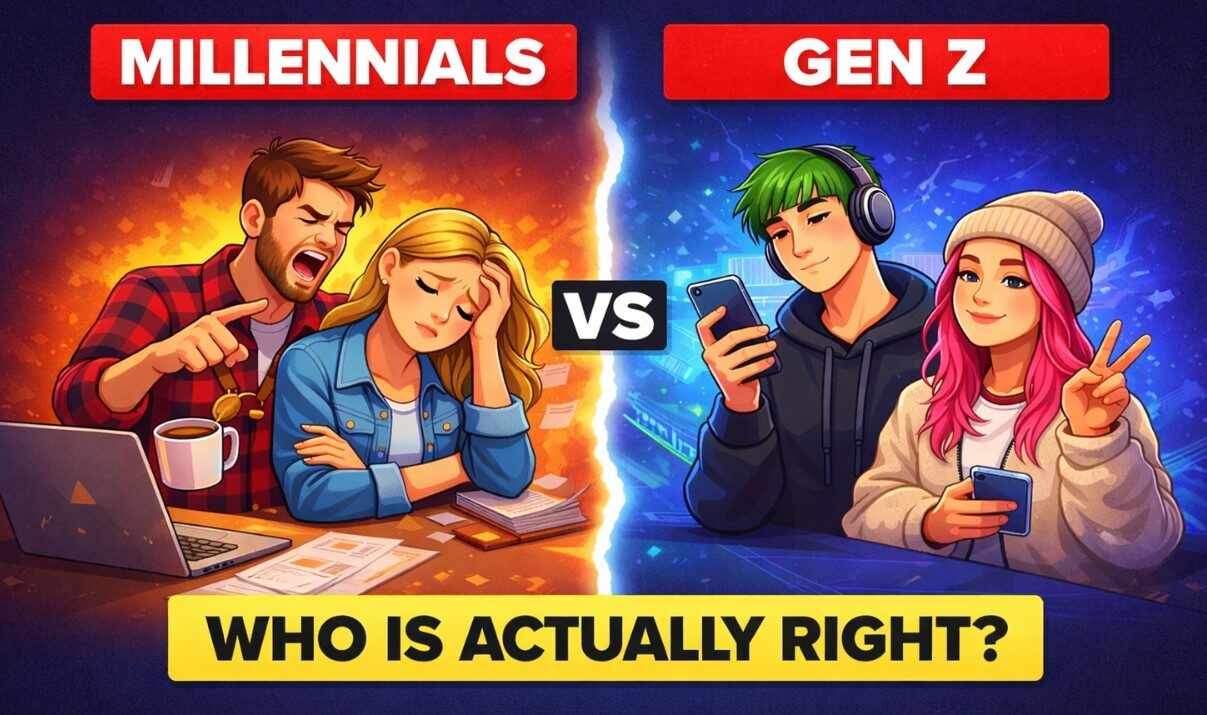
There is a quiet shift happening across workplaces, homes, and social media feeds not a conflict in the traditional sense, but a generational contrast that is reshaping how the world thinks, works, and lives.
On one side are Millennials a generation that came of age alongside the internet, watched the rise of smartphones, and helped build the foundation of today’s digital economy. On the other are Gen Z, the first true digital natives, who have never known a world without instant connectivity, algorithm-driven content, and social media as a primary form of communication.
Together, they are not just coexisting they are redesigning culture in real time.
Millennials are often credited with normalising flexibility: remote work, freelance careers, and the idea that jobs should adapt to life, not the other way around. They embraced experiences over possessions, travel over stability, and side hustles as a second identity.
Gen Z, however, is taking a different tone more cautious, more direct, and in many ways more demanding. For them, mental health is not a buzzword but a baseline expectation. Work-life balance is not a luxury but a requirement. And authenticity is not optional; it is currency.
In offices and virtual meetings, this contrast is becoming increasingly visible. Managers describe Millennials as adaptable and optimistic, while Gen Z employees are more likely to question structures, demand transparency, and challenge traditional hierarchies from day one.
Even in digital spaces, the differences are subtle but powerful. Millennials curated Instagram feeds; Gen Z dismantles them. Millennials built personal brands; Gen Z often resists being defined by one.
Yet beneath the stereotypes lies a shared reality: both generations are navigating economic uncertainty, rising living costs, and an always-online world that never truly switches off. Both are reacting in different ways to the same global pressures.
Experts say this is not a rivalry, but an evolution. Each generation is responding to the failures and lessons of the one before it, pushing society toward a new balance between ambition and wellbeing, productivity and presence, identity and privacy.
And as Gen Z continues to enter the workforce and Millennials move into leadership roles, the tension between the two is not fading it is becoming the engine of change.
Because in the end, this is not just about age groups. It is about how humans adapt when the world changes faster than ever before.




+ There are no comments
Add yours