







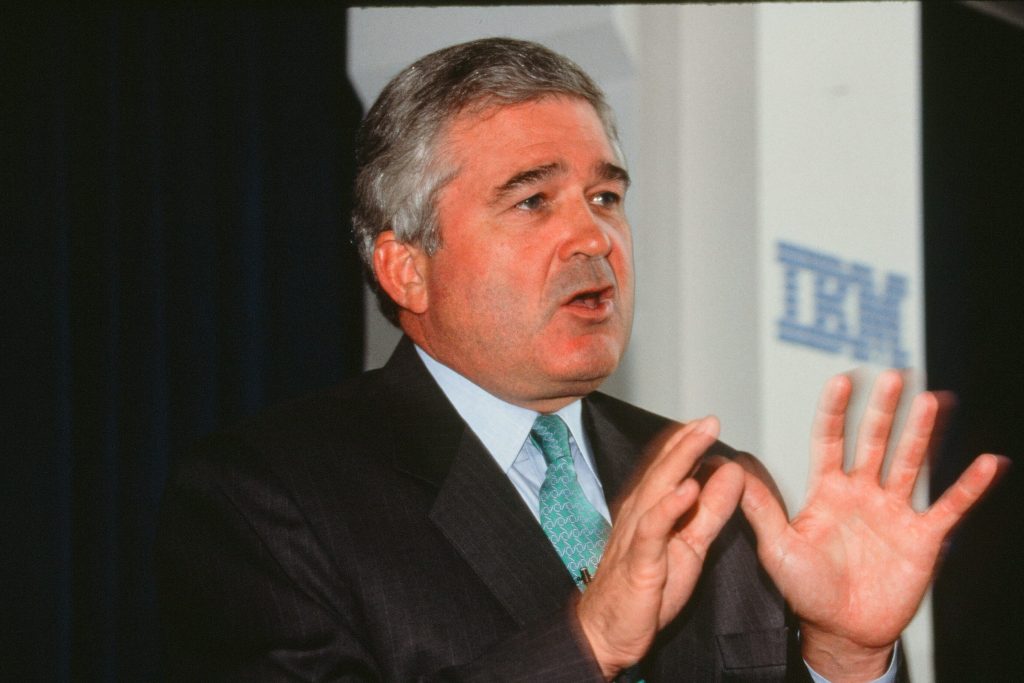
Louis Vincent Gerstner Jr., the celebrated corporate leader widely credited with rescuing International Business Machines Corp. (IBM) from near collapse and transforming it into a modern technology powerhouse, has died at the age of 83. His passing was confirmed in an internal announcement from current IBM Chairman and CEO Arvind Krishna, who praised Gerstner’s pivotal role in changing the course of one of the world’s most iconic companies.
A Leader at a Crossroads: IBM in the Early 1990s
When Gerstner took the helm of IBM in April 1993, the company was in deep crisis. Once the undisputed giant of computing, IBM was bleeding money, losing market share to competitors, and facing both internal fragmentation and external pressure from fast-moving rivals in software and hardware. For the first time in decades, board members and analysts debated whether the storied company should even remain intact or be broken up into smaller “Baby Blue” units.
At that moment of uncertainty, IBM turned to Gerstner — an outsider to the traditional IBM executive ranks — marking a dramatic break from its long history of internally promoted CEOs. Prior to IBM, Gerstner had built a strong leadership reputation with stints at McKinsey & Company, American Express, and as CEO of RJR Nabisco, earning respect for his strategic thinking and operational discipline.
Strategic Overhaul: Transforming a Legacy Giant
Gerstner’s leadership at IBM was defined by bold decisions that reshaped the company’s direction:
- Abandoning the Break-Up Plan: Instead of dismantling IBM into semi-autonomous businesses, he unified the enterprise around a cohesive vision focused on customer needs and integrated technology solutions.
- Shifting to Services: Recognizing that pure hardware would not sustain IBM’s future, Gerstner pivoted the company toward business services, middleware, and consulting, positioning IBM as a trusted partner for enterprise digital transformation.
- Cultural Reform: He challenged IBM’s long-standing internal silos, replacing them with cross-company teamwork, accountability, and a performance-driven focus. Compensation was tied to corporate success rather than individual divisional results.
- Tough Restructuring: His tenure saw intense restructuring, including widespread layoffs and the sale of non-core assets like real estate and art collections — decisions that were painful but aimed at securing long-term viability.
- Technology and Market Focus: Gerstner also pulled back from less successful ventures — notably discontinuing the OS/2 operating system effort — and prioritized technologies aligned with future enterprise needs such as server infrastructure, middleware, and e-business solutions.
The Results: Financial and Strategic Turnaround
Under Gerstner’s leadership from 1993 to 2002, IBM’s fortunes dramatically improved. By the end of his tenure:
- IBM’s services revenue grew significantly, reflecting its shift toward solutions and consulting.
- The company’s stock price increased manifold, and its market capitalization expanded substantially, as investors regained confidence in the business model and strategy.
These achievements are widely studied in business schools as a masterclass in corporate turnarounds — showing how decisive leadership and customer-centric transformation can revitalize even the most entrenched legacy companies.
Life Beyond IBM and Lasting Legacy
After retiring from IBM in 2002, Gerstner continued to influence the business world. He served as chairman of the Carlyle Group until 2008, where he oversaw expansion into new markets. Beyond corporate roles, he became deeply involved in philanthropy, especially through Gerstner Philanthropies, supporting education, biomedical research, social services, and environmental initiatives across major U.S. cities.
Gerstner was also an accomplished author, penning influential books on leadership and change, including Who Says Elephants Can’t Dance?, which reflects on his experience turning IBM around during one of its most challenging eras.
Remembering a Titan of Industry
Tributes from leaders and colleagues highlighted Gerstner’s direct leadership style, his ability to balance short-term execution with long-term thinking, and his emphasis on innovation that delivers real value to clients. Arvind Krishna, in his announcement to IBM employees, noted how Gerstner’s commitment to listening, adaptation, and relentless focus on customer needs helped reshape the company for future generations.
Gerstner’s influence on IBM and on corporate leadership more broadly will be remembered as a defining chapter in the history of global technology business.














+ There are no comments
Add yours