







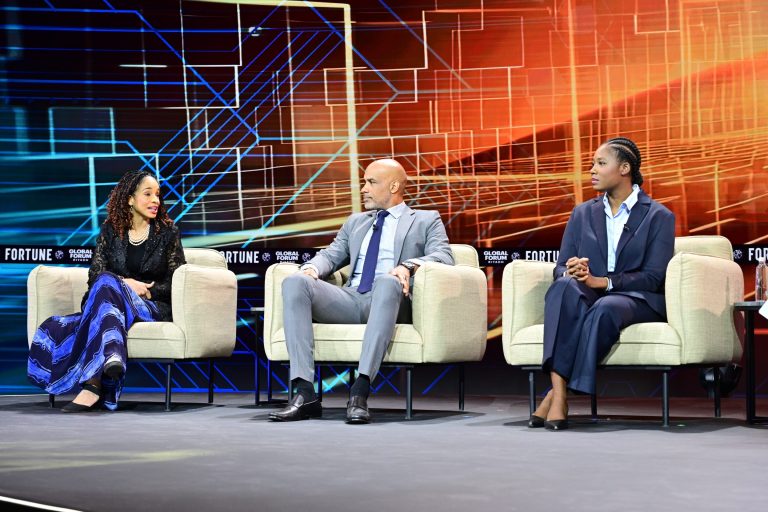
Artificial intelligence is not just transforming industries—it’s transforming continents. According to a former Nvidia executive speaking at the Fortune Global Forum 2025, AI and emerging technologies could become the greatest equalizers Africa has ever seen, reshaping its economy, education, and innovation landscape for decades to come.
Africa’s Digital Moment Is Here
For years, Africa was viewed primarily as a consumer of global technology, lagging behind Silicon Valley, China, and Europe in innovation and digital infrastructure. That perception is changing fast. With a population of over 1.4 billion people—60% of whom are under 25—the continent is on the verge of an AI-driven renaissance.
“AI gives Africa an unprecedented opportunity to leapfrog traditional stages of development,” said Kwame Mensah, former Nvidia executive and current AI strategist at the Africa Innovation Lab. “For the first time, Africa doesn’t have to follow the world—it can lead in its own way.”
From Kenya’s Silicon Savannah to Nigeria’s Yabacon Valley and South Africa’s Cape Innovation District, tech hubs across the continent are buzzing with startups that are using artificial intelligence to solve local problems in health, agriculture, finance, and education.
AI as a Tool for Equal Access
Artificial intelligence is breaking barriers in sectors that have long struggled with inequality and access. In healthcare, startups like Zuri Health and mPharma are using AI-powered diagnostics and data analytics to deliver medical services to rural communities.
In education, platforms like Ubongo and uLesson are leveraging AI to personalize learning for millions of students across multiple languages and learning levels.
“AI is creating a bridge between rural and urban populations,” Mensah explained. “It’s allowing a child in a remote village in Ghana to learn from the same resources as a student in New York or London.”
The same holds true in agriculture, where AI-driven weather forecasting and soil analytics are helping farmers increase yields and reduce waste. According to the World Bank, AI in agriculture could boost Africa’s GDP by $43 billion annually by 2030 if adopted widely.
Overcoming Infrastructure Challenges
Despite the optimism, challenges persist. Limited internet connectivity, unreliable electricity, and insufficient data infrastructure still hinder AI’s full potential. But companies are innovating around these constraints.
For instance, Google’s Equiano subsea cable has dramatically improved data speeds in West and Southern Africa, while Starlink is expanding internet access to previously unreachable areas. Governments, too, are stepping in—Nigeria, Kenya, and South Africa have all introduced national AI strategies aimed at building local talent and data governance frameworks.
Mensah emphasized that “AI doesn’t have to wait for perfect conditions. Africa is uniquely positioned to innovate under constraints—and that’s often where the best ideas come from.”
The Rise of Homegrown AI Startups
Africa’s AI ecosystem is no longer dependent on foreign investment alone. Homegrown venture capital funds and regional accelerators are emerging rapidly. Funds like Future Africa, TLcom Capital, and Norrsken22 are supporting startups that focus on African solutions for African problems.
Startups such as DataProphet (South Africa), DeepLearning Indaba (Pan-African), and Synapse Analytics (Egypt) are gaining international recognition for their contributions to industrial automation, AI research, and data analytics.
Global tech giants are also taking notice. Nvidia, Microsoft, and Google are partnering with local developers to build AI labs, offer training programs, and fund innovation challenges that empower African youth.
AI and Job Creation: The Human Side of Tech
While automation often raises fears of job loss, Africa’s leaders view AI as a job creator, not a threat. The technology is expected to generate millions of new roles in data science, machine learning, robotics, and digital entrepreneurship.
By 2035, Africa’s working-age population will exceed 1 billion people, making skills training critical. “AI won’t replace people—it will replace people who don’t adapt,” Mensah warned. “That’s why digital education must be central to every country’s development policy.”
To that end, initiatives like Andela, ALX Africa, and Google’s AI Research Center in Ghana are training thousands of engineers and developers to build the continent’s digital future.
Africa’s Competitive Edge
Unlike developed nations that face aging populations and rigid systems, Africa’s youth, agility, and adaptability give it a unique competitive edge in the AI race. Young innovators are blending traditional knowledge with cutting-edge technology, creating solutions that are not only practical but sustainable.
For instance, AI-powered climate models are helping communities adapt to changing weather patterns, while fintech platforms are bringing financial inclusion to millions of unbanked citizens.
“AI is Africa’s great equalizer because it democratizes opportunity,” Mensah said. “It allows a small team in Nairobi or Lagos to compete on the same stage as a startup in San Francisco.”
Looking Ahead: A Future Defined by Inclusion
As AI adoption accelerates, experts believe Africa could contribute up to $1.2 trillion to global GDP by 2030 through AI-driven innovation. But to reach that potential, collaboration between governments, private sector players, and international partners will be key.
The continent’s success will depend on building ethical AI systems, protecting data privacy, and ensuring inclusivity across gender, geography, and income levels.
“Africa’s AI story is not about catching up—it’s about leading differently,” Mensah concluded. “If we focus on inclusive growth, AI won’t just change Africa—it will change the world.”












+ There are no comments
Add yours