






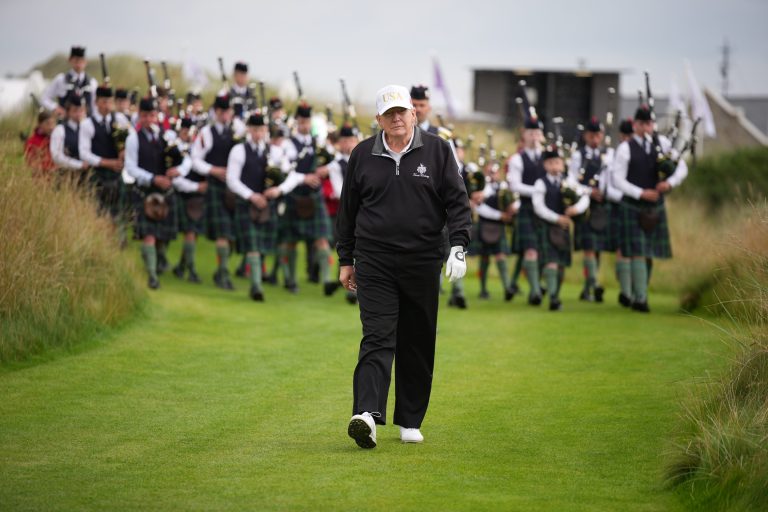
Former U.S. President Donald Trump’s golf empire in the United Kingdom has long been pitched as a crown jewel of his international business portfolio. With scenic views, championship-level courses, and global prestige, the Trump golf brand in Scotland and Ireland has been marketed as a symbol of luxury. Yet behind the manicured greens lies a troubling reality: mounting debt, chronic losses, and ongoing financial uncertainty.
Trump’s U.K. courses, particularly Trump Turnberry in Ayrshire and Trump International Golf Links in Aberdeenshire, have become emblematic of how prestige projects can evolve into financial sand traps.
The Promise of Trump’s Golf Vision
When Trump entered the U.K. golf market more than a decade ago, he promised transformation: world-class resorts, thousands of jobs, and economic boosts to local communities.
Trump Turnberry, purchased in 2014, was envisioned as a global destination after millions were spent on renovations.
Trump International Golf Links in Aberdeen, opened in 2012, was marketed as one of the best new courses in the world, with plans for luxury hotels and housing developments.
The vision was bold, but the financial results have been far less impressive.
Debt and Operating Losses
Financial filings over the past several years show a consistent theme: large operating losses and heavy debt loads.
Turnberry has repeatedly reported multi-million-pound losses, despite its global reputation.
The Aberdeen course has also struggled, with revenues unable to match the original investment and ongoing operating costs.
Both properties are supported by loans from Trump-affiliated companies, raising questions about long-term sustainability.
Analysts point out that while the courses bring prestige, they have functioned more like money pits than profit centers.
Why the Courses Struggle
Several factors explain why Trump’s U.K. golf ventures continue to lose money:
High Renovation Costs: Turnberry’s renovations required significant capital outlay, much of it financed through loans.
Challenging Golf Market: The sport has struggled to attract new players in the U.K., with course closures rising nationwide.
Remote Locations: Both properties are in relatively isolated areas, limiting casual tourism traffic.
Brand Controversy: Trump’s political career and controversies have polarized public opinion, with some golfers and organizations avoiding his resorts.
Brexit and Economic Pressures: Broader economic challenges in the U.K. have reduced spending on luxury leisure activities.
Debt Restructuring and Family Involvement
In recent years, the Trump Organization has relied on intercompany loans to keep the courses afloat. Trump family members, including Eric Trump, have been closely involved in managing the properties.
While the strategy has kept the resorts operating, critics argue that it merely reshuffles debt without solving the underlying profitability issues. Some experts even suggest that the golf courses function more as status symbols than serious business ventures.
The Political and Financial Intersection
Trump’s U.K. golf properties are not just financial assets—they are also political flashpoints.
During his presidency, his visits to Turnberry drew scrutiny over taxpayer costs for security and travel.
Local communities remain divided: some welcome the jobs and tourism, while others resent the environmental and social impact of large-scale development.
The financial struggles also raise questions about the broader health of Trump’s global business empire, particularly as legal and political challenges mount in the United States.
Global Market Context
Trump is not alone in struggling with golf investments. The global golf industry faces structural challenges:
Declining participation rates among younger generations.
Rising maintenance and labor costs.
Increased competition from alternative leisure activities.
Even successful golf resorts often rely on real estate development, luxury hotels, and events to generate profits. Trump’s projects, by contrast, have often lagged in diversifying their revenue streams.
What the Future Holds
Despite financial headwinds, the Trump Organization continues to market its U.K. courses as elite destinations. Upcoming golf tournaments, hospitality expansions, and new marketing strategies may bring in additional revenue.
Yet analysts remain skeptical. Without fundamental shifts in strategy, the courses may remain heavily indebted assets that require constant financial support.
Key Takeaways
Trump owns two major U.K. golf properties: Trump Turnberry and Trump International Aberdeen.
Both have faced chronic financial losses despite significant investments.
Heavy reliance on debt and intercompany loans raises questions about sustainability.
Broader challenges in the golf industry and Trump’s personal brand controversies compound the difficulties.
While still prestigious, the courses have become symbols of debt-heavy luxury rather than profit-driven success.
Donald Trump’s U.K. golf courses, once touted as global landmarks of luxury and sport, remain stuck in a financial bunker. Lavish investments and bold promises have yet to translate into profitability. Instead, the properties highlight the risks of blending prestige, politics, and business in an industry already facing long-term decline.
For now, Trump’s golf empire in Britain looks less like a championship fairway and more like a debt-heavy sand trap—difficult to escape, no matter how many strokes are taken.











+ There are no comments
Add yours