








Few topics spark as much debate as artificial intelligence. Headlines warn of mass layoffs, disappearing industries, and a future where machines replace human workers. But from where we sit—as one of the largest employment agencies in the world—the picture looks very different. AI is not a job killer. It is a job shifter. And we can already see where the world of work is moving.
For over a century, every major technological revolution has been greeted with fear. The steam engine, electricity, the internet—each was predicted to wipe out jobs. And each time, while certain roles did fade, far more opportunities emerged. AI is following that same path. Yes, it will transform industries. Yes, it will automate repetitive tasks. But it will also create entirely new categories of work, enhance productivity, and open doors for people with skills that didn’t exist just a few years ago.
The Reality of AI in Today’s Workplace
When we analyze hiring data across regions and industries, the same pattern emerges: jobs are not disappearing at scale—they are shifting. Tasks that are routine, manual, or highly repetitive are increasingly being automated. But at the same time, companies are seeking workers who can manage, interpret, and apply AI tools to solve real business challenges.
For example:
Customer service roles are evolving into customer experience specialists, where AI handles simple inquiries, but humans step in to resolve complex issues with empathy.
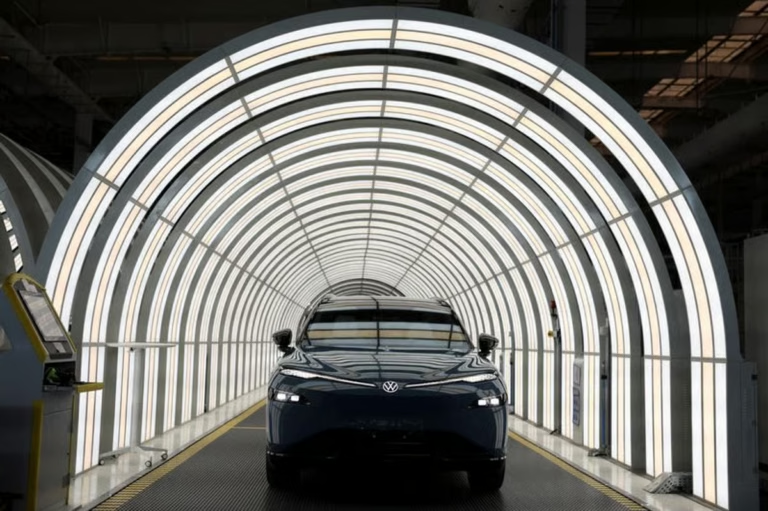
Manufacturing line workers are becoming robotics operators and maintenance specialists, overseeing machines that handle physical labor.
Data entry clerks are transitioning into data analysts, interpreting AI-generated insights to guide strategy.
Healthcare support staff are being trained in AI-assisted diagnostics, where technology accelerates detection but human expertise ensures accurate care.
This is not the end of work. It is the transformation of work.
Why the “Job Killer” Narrative Is Misleading
The narrative that AI will simply erase jobs fails to recognize two important truths:
History shows adaptation always outpaces destruction. When ATMs were introduced, people thought bank tellers would vanish. Instead, the number of bank branches grew, and tellers shifted to relationship-based roles. Similarly, AI will allow workers to focus on higher-value tasks that machines cannot replicate.
AI cannot replace uniquely human skills. Creativity, empathy, problem-solving, and leadership remain irreplaceable. Employers are doubling down on these traits, even as they adopt new technology.
Our global data reveals that employers are not scaling back their workforce en masse—they are reshaping job descriptions, investing in reskilling, and hiring for hybrid roles that combine technical and human expertise.
Where Jobs Are Moving: The Growth Areas We See
Based on our position at the center of the labor market, we can already identify several growth areas fueled by AI adoption:
Tech and Digital Transformation: Demand for AI engineers, data scientists, and software developers continues to soar. But equally important are roles in product management, cybersecurity, and ethics that guide responsible AI use.
Healthcare and Life Sciences: With AI accelerating drug discovery and diagnostics, new jobs are emerging for technicians, analysts, and coordinators who can integrate technology with patient care.
Green and Sustainable Jobs: AI is driving efficiencies in energy, logistics, and agriculture, creating opportunities in renewable energy management, smart logistics, and precision farming.
Human-Centered Roles: Teachers, nurses, social workers, and creative professionals remain in high demand, with AI tools enhancing—not replacing—their impact.
Skilled Trades and Maintenance: As factories and warehouses adopt robotics, skilled technicians who can manage, repair, and optimize machines are more valuable than ever.
Reskilling: The Key to Unlocking Opportunity
If AI is shifting jobs, then reskilling is the bridge that allows workers to move with confidence. The greatest challenge ahead is not the elimination of jobs, but the pace at which workers adapt their skills to new requirements.
Employers are recognizing this. Training budgets are increasing, partnerships with universities and online platforms are multiplying, and governments are beginning to prioritize workforce development in their AI policies. Workers who embrace lifelong learning will find not fewer opportunities, but more—and better ones.
A Message of Optimism
As one of the world’s largest employment agencies, we see millions of job postings, placements, and career transitions every year. The data tells a clear story: AI is not shrinking the workforce. It is shifting it. And for those who are willing to adapt, the future of work is full of promise.
The real challenge is not whether AI will take jobs—it’s whether businesses, governments, and workers will move fast enough to embrace change. By focusing on skills, investing in training, and designing technology that supports human potential, we can ensure AI becomes a powerful tool for opportunity, not fear.
The Future of Work Is Human + AI
AI is here to stay, but so are we. The most powerful organizations of the future will not be those that replace humans with machines, but those that combine the strengths of both. Humans bring creativity, judgment, and emotional intelligence. AI brings speed, precision, and scale. Together, they can redefine productivity and growth.
So let’s stop framing AI as a job killer. The truth is far more exciting. AI is a job shifter—and with the right strategies in place, it can be the catalyst for one of the greatest periods of job creation and transformation the world has ever seen.












+ There are no comments
Add yours