






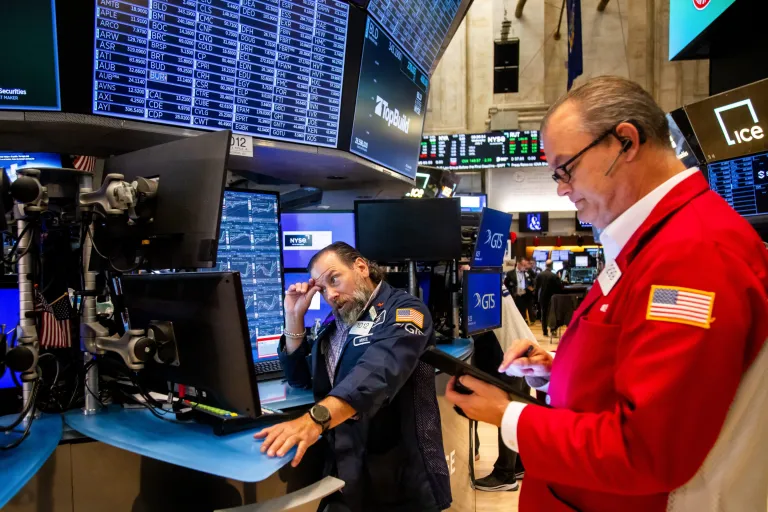
Wall Street is on edge again. Early Monday morning, Dow futures slid as key officials from former President Donald Trump’s policy team warned that if re-elected, the administration would have limited time before retaliatory tariffs and global economic consequences “boomerang back” on the U.S. economy.
The comments have triggered a fresh wave of investor anxiety, particularly as the 2025 campaign cycle heats up and Trump’s economic agenda—especially his aggressive trade policies—returns to the spotlight.
As global markets digest the renewed possibility of sweeping protectionist measures, analysts are increasingly concerned that a second Trump administration might reintroduce or escalate tariffs on China, Mexico, and European Union nations, in a move that could shock both supply chains and consumer prices.
Dow Futures Slide: Wall Street Reacts to Trade War Signals
At around 6:00 AM ET, Dow Jones Industrial Average futures were down nearly 220 points, while S&P 500 futures dropped 0.6% and Nasdaq 100 futures fell 0.5%. Traders cited growing unease around Trump’s proposed universal baseline tariffs, which could be as high as 10% on all imports—and potentially much higher for Chinese goods.
This market movement comes just days after Larry Kudlow, Trump’s former economic advisor, and Peter Navarro, his ex-trade czar, said in separate interviews that “there’s a window of action, but not much breathing room” before other countries retaliate with tariffs of their own, triggering inflation, stagnation, and political fallout.
“If we impose broad tariffs quickly, there might be an initial boost for domestic manufacturers,” Navarro said, “but within months, our trading partners will strike back—and hard. This isn’t 2018. They’re prepared.”
The Trump Trade Playbook 2.0: What We Know
Trump’s 2025 campaign has hinted at a sweeping trade overhaul, including:
A universal 10% tariff on all imports
60% or higher tariffs on Chinese goods
Use of tariffs to penalize countries with carbon-heavy manufacturing
Tariff revenue being used to fund “Made in America” initiatives
While the administration believes these tariffs could reduce trade deficits, promote domestic jobs, and curb reliance on Chinese manufacturing, economists warn of serious downsides: consumer inflation, supply chain instability, and reduced global investment in U.S. businesses.
“We’re looking at 1970s-style stagflation if this isn’t implemented with surgical precision,” warned Mark Zandi, Chief Economist at Moody’s Analytics.
Investors Brace for a Repeat of the 2018-2019 Trade War
Wall Street vividly remembers the rollercoaster of 2018–2019, when Trump first imposed tariffs on Chinese steel, aluminum, and hundreds of consumer goods. That move sparked tit-for-tat retaliation, resulting in:
Billions in U.S. agricultural losses (offset temporarily by federal subsidies)
Increased prices on consumer electronics, clothing, and furniture
Market volatility that suppressed investor confidence
A slowdown in global trade and industrial production
Now, with the threat of a “Trade War 2.0”, many investors are rotating out of highly exposed sectors like retail, tech, and manufacturing, and shifting into safe-haven assets like gold and U.S. Treasury bonds.
Corporate America’s Warning: “Tariffs Are a Tax on Americans”
The business world isn’t staying silent either. The U.S. Chamber of Commerce, National Retail Federation, and Business Roundtable have already issued preliminary memos cautioning the public and lawmakers about the dangers of sweeping tariffs.
“Tariffs are not paid by foreign governments—they’re paid by U.S. businesses and consumers,” said a spokesperson for the National Retail Federation. “They raise prices, disrupt planning, and create uncertainty that chokes investment.”
Apple, Walmart, General Motors, and Nike were among the firms hardest hit during the 2018–2019 tariff battles. Analysts predict that these companies, along with hundreds of smaller U.S. importers, would once again face margin pressure if Trump’s plan moves forward.
Global Allies Signal Readiness to Retaliate
Another concern for U.S. investors: global backlash. Officials from the European Union, Canada, and China have already indicated that any aggressive U.S. tariff regime would be met with reciprocal measures.
The EU Trade Commission hinted it may reintroduce tariffs on U.S. agriculture and industrial goods.
China’s Commerce Ministry said it “reserves the right to take all necessary actions” to protect Chinese exporters.
Mexico has warned that any tariff pressure would “violate the spirit of USMCA” and harm cross-border commerce.
In essence, the same boomerang effect that Trump’s own advisors warned about—where U.S. tariffs trigger immediate, targeted retaliation—is already being modeled by America’s top trading partners.
What This Means for the 2025 Economy
With inflation still a concern and interest rates already high, the U.S. economy may not be well-positioned to absorb a new wave of tariffs. Analysts from Goldman Sachs, Barclays, and Morgan Stanley agree that:
Consumer prices could surge again
Retail and import-heavy sectors would face earnings downgrades
The Fed might delay rate cuts to combat imported inflation
Global investment into the U.S. could slow
For now, the tariff proposals remain campaign policy—not official government action—but markets are clearly responding to the rising probability that the next administration could pursue a protectionist, isolationist agenda.
Final Thoughts: A Familiar Storm Cloud Over Wall Street
The fall in Dow futures is more than just a market fluctuation—it’s a sign that investors are deeply uneasy about returning to a trade war era that many hoped was over.
Trump officials may believe there is still “limited breathing room” to act before damage is done, but if the lessons from the last tariff cycle are any guide, the cost of miscalculation could be steep—for markets, consumers, and the global economy alike.













+ There are no comments
Add yours