






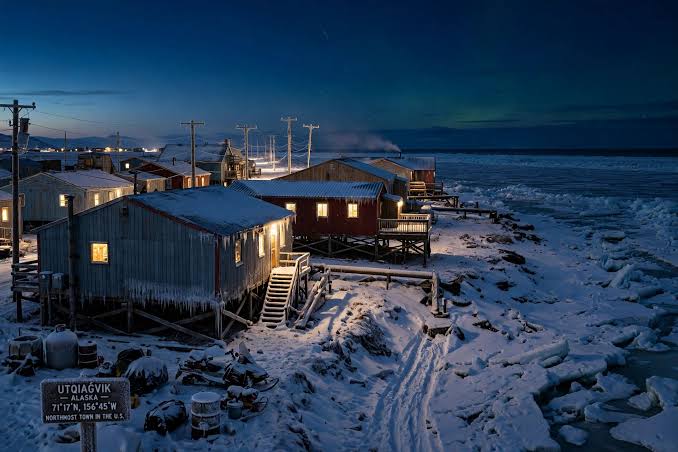
As the final sunset of 2026 fades over Utqiaġvik, residents prepare for nearly two months without seeing the sun rise, as one of Earth’s most extraordinary natural phenomena takes hold above the Arctic Circle.
Imagine watching the sun disappear beyond the horizon in November and knowing that you will not see it rise again for more than two months. For the residents of Utqiaġvik, Alaska, this is not a fictional winter adventure but an extraordinary part of everyday life. The northernmost town in the United States has witnessed its final sunset of 2026 on November 18, marking the beginning of approximately 65 days of polar night.
Located above the Arctic Circle, Utqiaġvik experiences one of the most dramatic seasonal changes on the planet. The town will remain without a sunrise until January 23, 2027, when the sun is expected to return above the horizon, ending a long period of continuous darkness.
The phenomenon, known as polar night, occurs because of the Earth’s tilted axis. During winter, the Northern Hemisphere tilts away from the sun, and locations far enough north remain outside direct sunlight for extended periods. In Utqiaġvik, the sun travels below the horizon rather than rising into the sky, creating weeks of darkness that transform the surrounding Arctic landscape.
However, the town does not remain completely black throughout the day. Around midday, residents experience a brief period of twilight when the sky becomes lighter, often displaying beautiful shades of deep blue, purple and orange. This unusual natural light creates an almost otherworldly atmosphere across the snow-covered landscape.
For adventurous travellers and photographers, the polar night offers a rare opportunity to experience the Arctic during one of its most mysterious seasons. The darkness can provide excellent conditions for observing the northern lights, although visibility depends on weather conditions, cloud cover and solar activity. Snow-covered landscapes, frozen coastlines and dramatic Arctic skies also create unforgettable opportunities for winter photography.
Life during these months, however, requires considerable preparation. Temperatures can fall dramatically, strong Arctic winds can make conditions even more challenging, and residents must adapt their daily routines to limited natural daylight. Warm clothing, reliable transportation and careful planning are essential parts of surviving the extreme winter environment.
Utqiaġvik is also home to the Iñupiat people, whose communities have lived in the Arctic for generations. Their knowledge, traditions and deep relationship with the changing seasons are central to life in this remote region. The polar night is not simply a tourist attraction but an important part of the environment and cultural identity of the community.
As January approaches, anticipation gradually builds for the return of sunlight. When the sun finally rises above the horizon on January 23, 2027, it will mark the end of one of the longest and darkest periods of the year.
For much of the world, winter means shorter days and colder evenings. But in this remote corner of Alaska, winter means something entirely different: 65 days without a sunrise, extraordinary twilight skies and an Arctic wilderness that reveals its most mysterious side.
In Utqiaġvik, the darkness is not the end of the day. It is an entire season of life, waiting patiently for the sun to return.







+ There are no comments
Add yours