







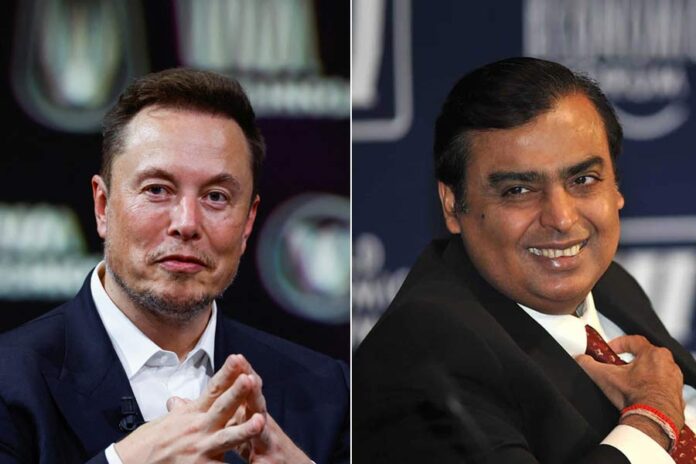
Elon Musk has escalated his dispute with Indian billionaire Mukesh Ambani, questioning the Reliance Industries chairman’s influence as Musk’s Starlink satellite internet service struggles to begin commercial operations in one of the world’s largest digital markets.
Musk’s latest remarks have intensified a growing battle over India’s satellite communications industry, where global technology ambitions, powerful domestic businesses and government regulations are increasingly colliding.
The SpaceX founder recently accused unnamed powerful business interests of trying to block Starlink’s entry into India, alleging that they wanted to preserve their dominance over the country’s telecommunications market. He subsequently singled out Ambani, asking on social media whether the Reliance chief was the “real boss of India”.
Musk has not publicly provided evidence to substantiate his allegations. India’s Ministry of Communications has rejected claims that the regulatory process is designed to disadvantage Starlink, saying the country’s rules are fair and non-discriminatory.
The ministry said Starlink, Eutelsat OneWeb and Reliance-backed Jio Satellite Communications were at broadly similar stages of the approval process, with security clearances and spectrum allocation still required before commercial services could begin.
The dispute highlights the enormous commercial opportunity at stake. With more than a billion internet subscribers, India represents a potentially lucrative market for satellite broadband, particularly in remote villages, mountainous regions and other areas where traditional telecommunications infrastructure can be difficult or expensive to deploy.
Starlink uses a network of low-Earth-orbit satellites to deliver internet connectivity without relying entirely on conventional ground-based networks. Musk has argued that the service could help expand access to high-speed internet for people who remain poorly connected.
However, Starlink is not entering an empty market. Reliance Jio, India’s largest mobile network operator, and Bharti Airtel are also preparing satellite internet services through their respective partnerships and investments. Both companies have signed agreements with SpaceX to distribute Starlink equipment and services in India, subject to government approval.
That creates an unusual commercial dynamic: companies preparing to compete against Starlink may also become its distribution partners.
The disagreement also follows an earlier debate over how satellite spectrum should be allocated. Reliance Jio argued that spectrum should be auctioned, while Starlink supported administrative allocation. India ultimately opted for administrative allocation, a decision consistent with Starlink’s preferred approach.
For Musk, the stakes extend beyond a delayed launch. India is an important market for his ambitions to expand satellite connectivity globally. For Ambani and other domestic players, satellite communications offer another opportunity to compete in a rapidly evolving digital economy.
Ultimately, the dispute will be decided not by social media exchanges but by regulatory approvals, investment and the ability to deliver reliable services to customers. Until those approvals are secured, millions of potential Indian users will have to wait to see how the satellite internet competition develops.








+ There are no comments
Add yours