







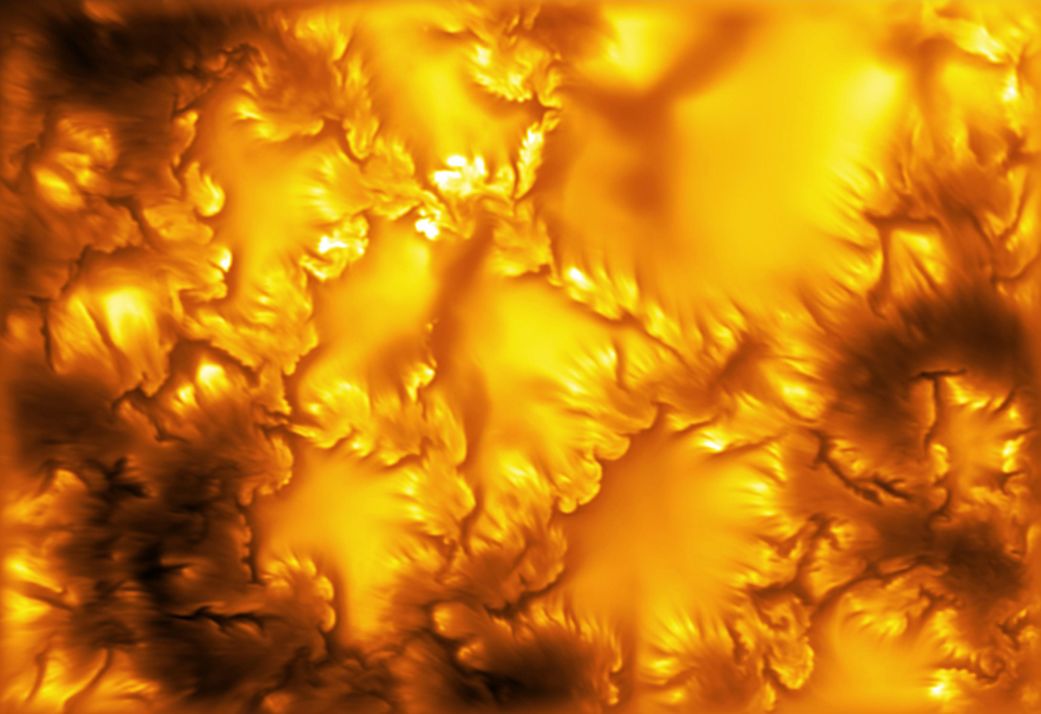
Scientists using the world’s most powerful solar telescope in Hawaii have captured the surface of the Sun in extraordinary detail, revealing patterns that could help researchers better understand the forces driving space weather.
The images were taken by the Daniel K. Inouye Solar Telescope, which is operated from Hawaii and is designed to study the Sun at an unprecedented level of detail.
Researchers observed swirling structures on the Sun’s surface that are linked to the movement of hot gases and the Sun’s powerful magnetic field. The patterns are associated with a phenomenon known as Kelvin-Helmholtz instability, which can occur when layers of fluid or gas move at different speeds.
The newly observed structures provide scientists with a closer look at how energy and material move through the Sun’s atmosphere. Understanding these processes is important because changes in the Sun’s activity can send bursts of energy and charged particles towards Earth.
Such events, commonly referred to as space weather, can interfere with satellites, communications systems and navigation networks. In severe cases, powerful solar storms can also affect electricity grids and other critical infrastructure.
Scientists say that studying the small-scale processes taking place on the Sun could eventually improve their ability to understand and predict these events before they reach Earth.
The observations also demonstrate the growing capabilities of modern solar telescopes. By resolving features that were previously difficult or impossible to see, researchers can investigate how the Sun’s magnetic field interacts with its hot, constantly moving plasma.
The findings have been published in the scientific journal Nature.
Researchers say continued observations will be needed to determine how widespread the newly observed patterns are and how they contribute to the Sun’s larger-scale activity.
A better understanding of these processes could ultimately help scientists improve space-weather forecasting and provide earlier warnings of solar activity capable of disrupting technology and infrastructure on Earth.










+ There are no comments
Add yours