







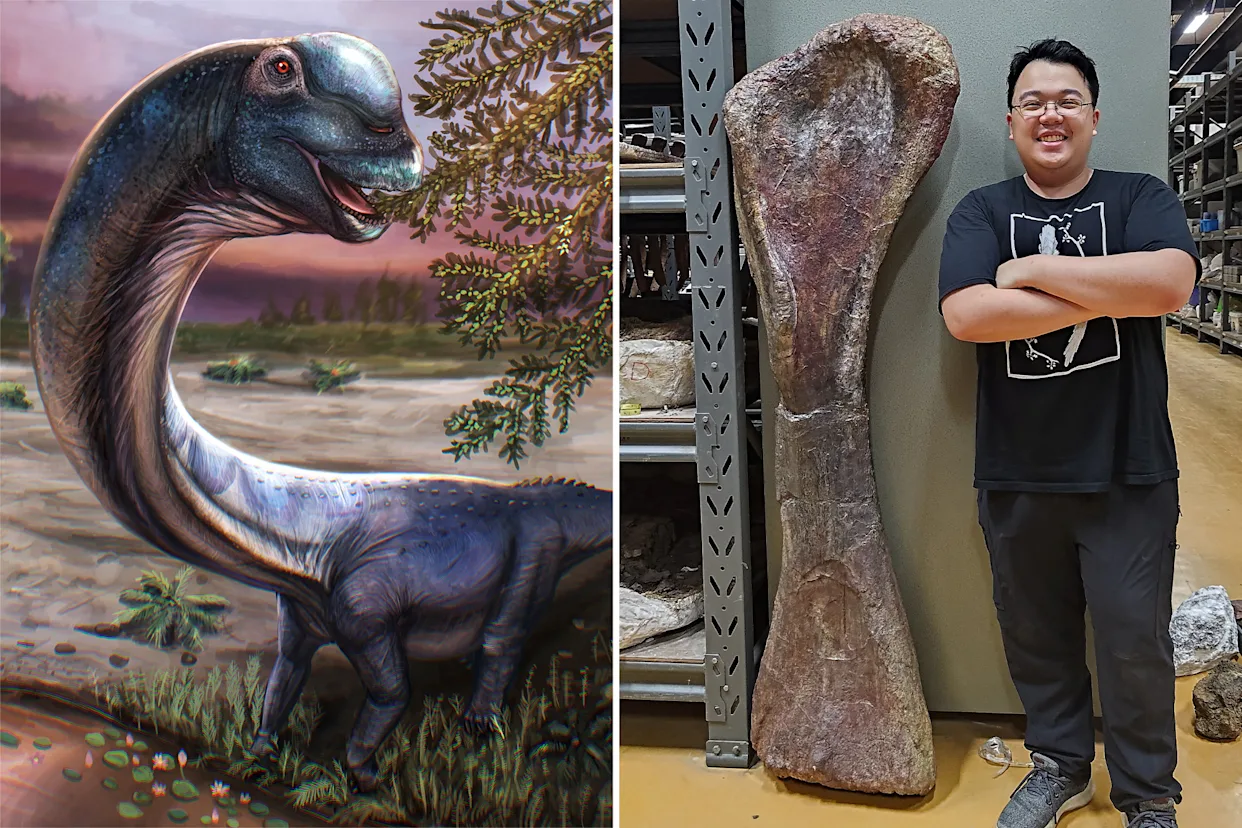
Scientists have officially named a newly identified giant dinosaur species, “Nagatitan chaiyaphumensis,” after fossils were discovered in Thailand’s Chaiyaphum Province nearly a decade ago. The discovery marks an important milestone in paleontology and becomes the country’s 14th confirmed dinosaur species.
The fossil remains were first unearthed during excavations in northeastern Thailand, an area known for its rich prehistoric heritage. After years of detailed study, researchers confirmed that the bones belonged to a previously unknown species of large herbivorous dinosaur. The name “chaiyaphumensis” was chosen to honor Chaiyaphum Province, where the discovery was made.
According to scientists, the dinosaur belonged to a group of long-necked sauropods, which were among the largest animals to ever walk the Earth. These dinosaurs are believed to have lived millions of years ago during the Mesozoic Era, feeding mainly on plants and vegetation. The size and structure of the fossil suggest that Nagatitan was a massive land creature, likely adapted to surviving in dense prehistoric forests and floodplain environments.
Paleontologists say the discovery provides valuable insight into the ancient ecosystems that once existed in Southeast Asia. It also helps researchers better understand how dinosaur species evolved and spread across different regions of the world. The find adds another important piece to the growing fossil record of Thailand, which has become one of the most significant dinosaur discovery sites in Asia.
Experts involved in the study highlighted that the research process took several years due to the careful preservation and reconstruction of fossil fragments. Advanced imaging and comparative analysis with other known dinosaur species were used to confirm that it was indeed a new species. Scientists also believe that more undiscovered dinosaur species may still be buried in the region.
The announcement has been widely welcomed by the global scientific community, as it strengthens Thailand’s reputation in the field of paleontology. Local researchers and museums are also expected to benefit from increased interest in fossil research and tourism.
With the naming of Nagatitan chaiyaphumensis, Thailand continues to play a key role in uncovering Earth’s prehistoric past, offering new clues about the giants that once roamed the planet millions of years ago.










+ There are no comments
Add yours