







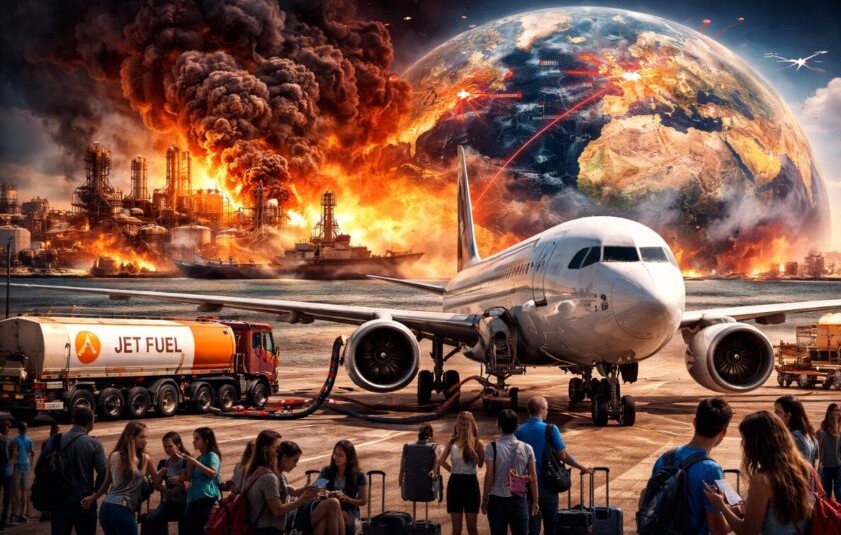
Global travel markets are entering a period of renewed strain as a developing jet fuel crisis linked to escalating tensions in the Middle East pushes up airline costs, threatens capacity cuts, and reshapes where and how people choose to travel.
The disruption stems from instability in key energy shipping routes, with markets reacting sharply to fears of constrained supply. As fuel costs rise, airlines are warning that higher operating expenses will likely be passed on to consumers through more expensive fares, reduced flight frequencies on less profitable routes, and tighter seat availability during peak seasons.
The pressure is already being felt across long-haul networks, where carriers operate on thinner margins and are more exposed to fuel volatility. Industry analysts say that if the situation persists, some airlines may be forced to adjust schedules or delay fleet expansion plans, particularly for emerging markets and secondary destinations.
At the same time, travellers are increasingly shifting their behaviour in response to rising prices. A noticeable trend toward “off-grid tourism” is emerging, with holidaymakers seeking cheaper, less commercialised destinations that offer lower accommodation and transport costs while avoiding crowded hotspots.
Among the fastest-growing alternatives are so-called “hidden Europe” destinations, including parts of Albania, Montenegro and rural regions of Eastern Europe. These locations are attracting attention for their affordability, natural landscapes and relative insulation from mass tourism pricing pressures.
Meanwhile, major global attractions are adapting to changing demand patterns. Several leading theme parks in the United States, Europe and Asia have announced updated pricing models, expanded off-peak discounts and new digital booking systems aimed at managing visitor flows more efficiently as travel costs rise and consumer behaviour shifts.
Despite the pressure on airlines and tourism operators, demand for travel remains resilient. However, the nature of that demand is changing—becoming more price-sensitive, more flexible, and increasingly shaped by economic uncertainty rather than pure destination preference.
For the global travel industry, the challenge is no longer just recovery or growth, but adaptation. Rising fuel costs are tightening the system, but they are also accelerating a broader shift in global tourism—away from traditional mass travel patterns and toward a more fragmented, selective, and cost-driven era of mobility.
The direction of travel is still upward. But the path is becoming narrower, more expensive, and far less predictable.








+ There are no comments
Add yours