







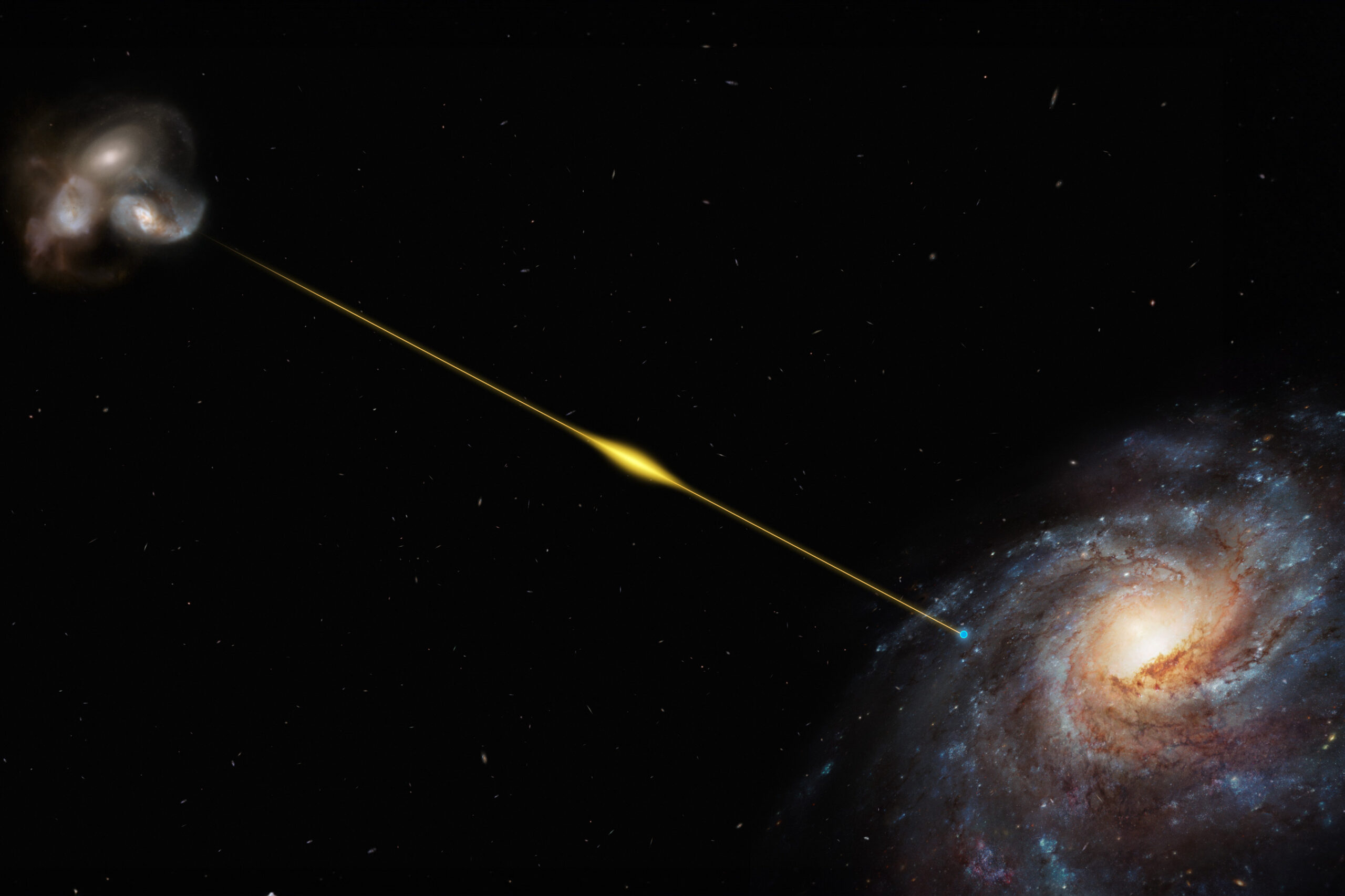
Astronomers have detected an unusually strong radio signal from a distant galaxy system about 8 billion light-years from Earth, in one of the most sensitive observations of its kind to date.
The emission, sometimes described in popular coverage as a “mega laser beam”, is in fact a naturally occurring hydroxyl megamaser — a rare cosmic phenomenon in which microwave radiation is amplified in space.
Researchers say the signal was produced in a violent environment, likely a system of colliding galaxies where vast clouds of gas and dust were compressed and energised. Under these extreme conditions, molecules such as hydroxyl can amplify radio waves, creating an intense, laser-like effect.
Despite its dramatic nickname, scientists stress the signal is not artificial and shows no evidence of any technological origin. Instead, it is a known astrophysical process that can occur during periods of rapid star formation and galactic interaction.
In some cases, the brightness of such signals can also be increased by gravitational lensing, where the gravity of massive objects between Earth and the source bends and magnifies the radio waves, making them easier to detect across vast cosmic distances.
Astronomers say discoveries like this help them study how galaxies evolved in the early universe, offering a rare glimpse into a period when cosmic collisions were more common and star formation was far more intense.
While the phrase “cosmic laser” has captured public attention online, researchers emphasise that the finding is firmly rooted in established physics, albeit at an extraordinary scale.
The results are expected to contribute to ongoing studies of galaxy formation and the behaviour of matter under extreme astrophysical conditions.









+ There are no comments
Add yours