







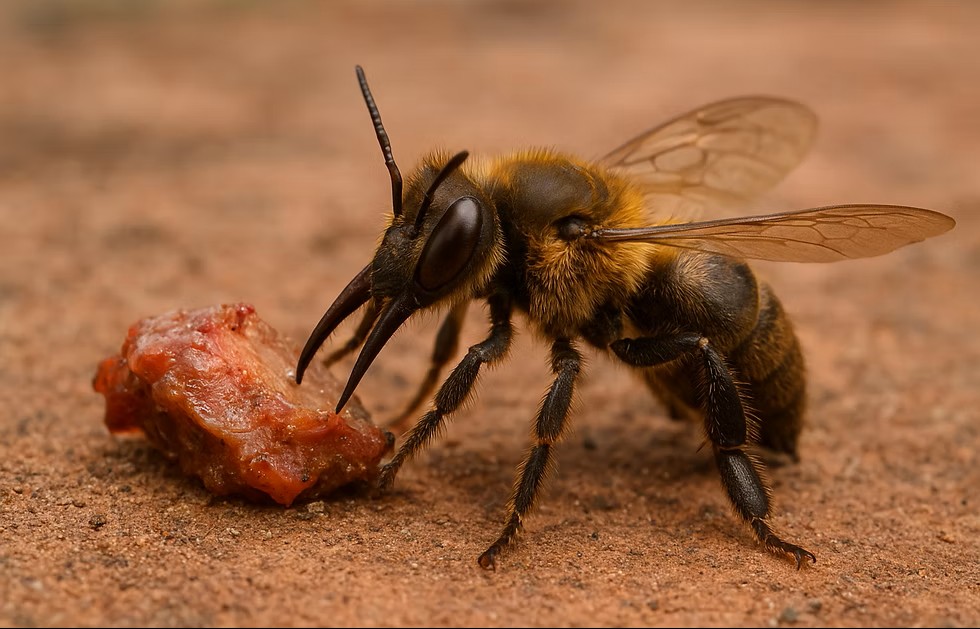
Deep within the humid rainforests of Central and South America lives one of nature’s most unexpected insects: Vulture bees. Unlike typical bees that depend on flowers for nectar and pollen, these remarkable insects have broken the rulebook of bee biology entirely. Instead of seeking blossoms, they have evolved to feed on rotting flesh.
This unusual diet places vulture bees among the rare few insects capable of surviving on carrion. Over time, they developed specialized enzymes that allow them to break down decaying animal tissue and extract nutrients that most other bees cannot access. This adaptation gives them a unique ecological advantage: they avoid direct competition with nectar-feeding species by exploiting a food source that few others can use.
Their foraging behavior is as striking as their diet. Worker bees search forest floors for carcasses of small animals or birds, carefully harvesting soft tissue using their strong, adapted jaws. Once they locate a food source, they transport pieces of flesh back to the hive using modified hind legs that function like carrying baskets. This process is methodical and surprisingly organized, reflecting the same efficiency seen in traditional honey-producing bees.
Inside the hive, the collected meat is stored and left to decompose further. Over time, it transforms into a nutrient-rich substance that resembles a thick, dark liquid. This processed material is then fed to developing larvae, providing the protein required for growth and survival in a protein-limited environment.
Physically, vulture bees differ from their pollen-loving relatives. They have reduced body hair, an adaptation that likely helps them avoid contamination while handling decaying matter. Their stronger mandibles allow them to tear through flesh, while their social structure—centered around queens, workers, and drones—remains similar to other bee species, even if their diet does not.
In the hidden world of tropical forests, vulture bees challenge the familiar image of bees as gentle nectar collectors. Instead, they reveal how evolution can push life into unexpected niches, transforming flowers into flesh and sweetness into survival strategy.










+ There are no comments
Add yours